
AI SDRs: Why Many Rollouts Underdeliver, and How to Make One Work

Introduction:
Imagine a sales leader ata 50-person software company. Last quarter, the company invested in an AI SalesDevelopment Representative (AI SDR). Thousands of emails went out, and dozensof meetings appeared on the dashboard.
Three months later, thepipeline had barely moved. Some meetings never happened, replies weredisappointing, and emails were starting to land in spam.
The problem wasn’t the AIitself. It was the system around it. Without reliable data, clear targeting andhuman oversight, an AI SDR creates activity, not revenue. The real question isnot how many messages it can send, but whether those messages lead to qualifiedconversations.
1. What Is an AI SDR?
A Sales DevelopmentRepresentative finds potential customers, researches them, starts conversationsand books meetings for the sales team. An AI SDR uses artificial intelligenceto do much of that work. Depending on the platform, it can:
• Research companies and buyers, andprioritise them against your Ideal Customer Profile (ICP).
• Spot buying signals, such as a newsales leader or a funding round.
• Draft personalised emails and LinkedInmessages.
• Manage follow-ups, classifyreplies and help schedule meetings.
• Keep CRM records up to date.
It is more than an emailsequencer with an AI writing button. Its value comes from connecting research,decisions, outreach and follow-up into one workflow. Autonomy varies: someplatforms need human approval for every message, while others run routine taskson their own within set rules.
2. How an AI SDR Works: From Signal toMeeting
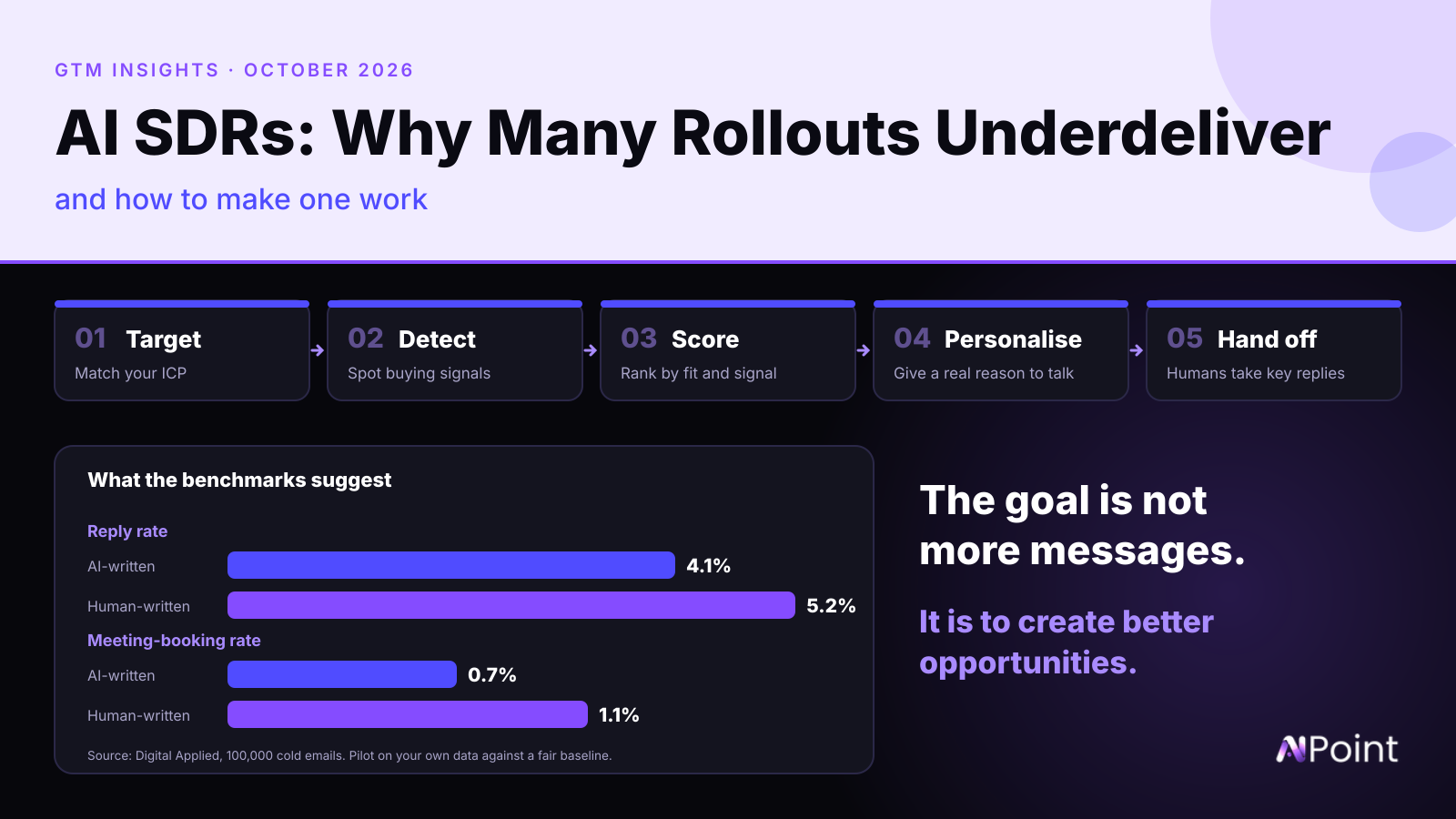
A good AI SDR workflowstarts with a reason to contact someone, not a list of email addresses. Ittypically runs in five stages:
1. Target. The system findscompanies that match your ICP and enriches their records with details such asgrowth, hiring, technology and decision-makers.
2. Detect signals. It watchesfor events that suggest a need, such as a new Head of Sales, expansion into anew market, a funding round or a change of technology. Not every signal meansintent to buy, so each must be judged against what you sell.
3. Score. Prospects are rankedby ICP fit, signal relevance and data confidence. A company that fits yourprofile and has just announced a relevant expansion goes to the top.
4. Personalise. The AI draftsa message that connects the prospect’s situation to a problem you solve.Mentioning recent news isn’t enough; it has to give a genuine reason to talk.
5. Respond and hand off.Routine replies are classified and followed up automatically. Positive replies,objections, pricing questions and high-value accounts go to a person, accordingto clear rules.
The goal is a smoothhandoff, not removing human judgement from the sales process.
3. Why AI SDR Rollouts Underdeliver
The same problems come upagain and again:
• Poor data. Incomplete oroutdated records mean the system contacts the wrong people with irrelevantmessages.
• Weak targeting. A vague ICPmakes it impossible for an AI agent to tell promising prospects from poor ones.
• Shallow personalisation.AI-written messages can sound polished while saying nothing relevant.
• Deliverability damage. Highvolumes of poorly targeted email drive up bounces and complaints, hurting thesender reputation of all your company’s email.
• Meetings without pipeline.More bookings don’t help if prospects don’t show up or aren’t qualified.
• Too little human oversight.AI can misread a reply, make unsupported claims or mishandle a complexquestion.
None of these is really anAI problem. Each is a data, process or measurement problem that automationmakes bigger.
4. What Does the Performance Data TellUs?
Published analyses suggestAI-written outreach still trails human outreach when other things are equal.Digital Applied’s analysis of 100,000 cold emails reported a 4.1%reply rate for AI-written emails, against 5.2% for human-written ones.Meeting-booking rates were 0.7% and 1.1% respectively.
Setup appears to mattermore than the tool. Laxis reports that outreach driven by buyingsignals and supervised by people performs far better than fully autonomouscampaigns, and Ghost reports higher meeting rates forcampaigns triggered by intent signals.
Treat these figures withcare. Several come from companies that sell sales technology, and each uses itsown definitions and methods. The practical lesson is simple: measureperformance on your own data, with a controlled pilot against a fair baseline.
5. AI SDR vs Human SDR vs Hybrid
rting point. AI handlesresearch, prioritisation and first drafts. People review important messages,qualify opportunities, handle complex replies and build relationships. Theright balance depends on product complexity, deal value, audience andthe risk of automated communication.
6. How to Implement an AI SDR
1. Write a clear ICP. Documenttarget industries, company sizes, roles and disqualifiers, specific enough thatany team member would apply them the same way.
2. Choose two or three signals.Pick signals with a credible link to customer need. A new sales leader mattersif you sell sales technology; a new regional office matters if you sellexpansion services. Validate them against real outcomes.
3. Prepare data and emailinfrastructure. Validate contacts, remove duplicates, configure emailauthentication and set responsible sending limits. Separate sending domains areno substitute for consent, compliance or good practice.
4. Run a controlled pilot.Choose one segment, run a limited campaign for a set period, and compare itwith a control group or your current process.
5. Keep people involved.Review messages before they are sent at first. Define how positive replies,objections, information requests, unsubscribes and unclear responses arehandled, and widen autonomy only once the system proves reliable.
6. Scale on evidence. Expandonly when the pilot improves qualified meetings or pipeline. If it onlyproduces more emails, revisit targeting, data, messaging and qualification.
7. Metrics That Actually Matter
Emails sent is easy tomeasure but says little. Track the whole funnel, and keep definitionsconsistent: an automated reply is not a positive response, and a booked meetingis not a qualified opportunity.
8. Deliverability, Brand Reputation andCompliance
An AI SDR speaks on behalfof your business, so its mistakes affect your reputation, not just yourcampaign.
• Deliverability. Configureemail authentication, monitor bounces and spam complaints, and follow youremail providers’ rules, such as Google’s emailsender guidelines. Aim for complaint rates well below the maximumthreshold, not at it.
• Brand reputation. A wrongfact, an inappropriate message or a reply that ignores a customer’s concern candamage trust. Clear messaging rules, verified data and human review reduce therisk.
• Compliance. In Australia,commercial email must meet the SpamAct 2003 rules on consent, sender identification and unsubscribing,and personal information is covered by the PrivacyAct 1988. International campaigns may also fall under the laws ofthe recipient’s country. Review these before launch.
Automation does not removea business’s responsibility for its communications.
9. The GTM Engineering Opportunity
An AI SDR is only aseffective as the go-to-market (GTM) system behind it. GTM Engineering connectsthe pieces: data sources, research, enrichment, signals, scoring, outreach, CRMprocesses and reporting.
Company Research → DataEnrichment → Data Validation → Signal Detection → Lead Scoring → PersonalisedOutreach → Reply Management → Sales Qualification → Performance Analysis
Each stage needs a clear purpose,defined inputs and measurable outputs. For example, a GTM Engineer might builda workflow that finds suitable companies, enriches their records, evaluatesbuying signals and prepares personalised messages for human review. A dashboardthen shows which signals, segments and campaigns produce qualified meetings andpipeline.
That creates a feedbackloop: real outcomes refine the targeting rules, the data and the automation.The AI SDR stops being an isolated tool and becomes part of a measurable revenuesystem.
Conclusion: Better Systems Create BetterSales Conversations
AI SDRs can make salesdevelopment more efficient, but automation alone does not guarantee results.Success depends on a clear ICP, reliable data, relevant signals, responsibleoutreach, honest measurement, and knowing where human judgement adds the mostvalue.
At AI Point, we focus onthe GTM foundations that make AI-driven growth work: understanding the rightcustomers, building reliable prospect data and identifying meaningful buyingsignals. With those in place, an AI SDR has a real basis for starting relevantconversations.
The goal is not to sendmore messages. It is to create better opportunities.
Sources and Further Reading
• Digital Applied, AI SDR Real Performance: 100K Email Analysis 2026
• Laxis, The State of AI SDR in 2026
• Ghost, AI SDR Benchmarks 2026: Reply Rates, Meeting Rates &Pipeline Volume to Expect
• Google, Emailsender guidelines
• Australian Communications andMedia Authority, Avoid sending spam
• Office of the AustralianInformation Commissioner, ThePrivacy Act
Related Blog


Ready to reach
new buyers?