
AI BDRs: How AI Is Changing Outbound Business Development

Introduction
Imagine an engineering consultancy that wants to enter a new market. It knows the kind of clients it wants, but it has few relationships there yet. The sales team has to find suitable companies, work out which ones are likely to need help soon, identify the decision-makers and write messages that speak to each company’s situation. Done by hand, that takes weeks.
This is where an AI Business Development Representative (AI BDR) can help. It can research target companies, analyse buying signals, find decision-makers and prepare relevant outreach.
But does using AI to send more messages actually create more business? Not necessarily. Automation without accurate targeting leads to irrelevant messages, a damaged reputation and wasted effort. The real value of an AI BDR is helping your team reach the right customer, at the right time, with a relevant reason to talk.
1. AI BDR vs AI SDR
The terms BDR and SDR mean different things in different organisations, and many vendors use them interchangeably. Broadly:
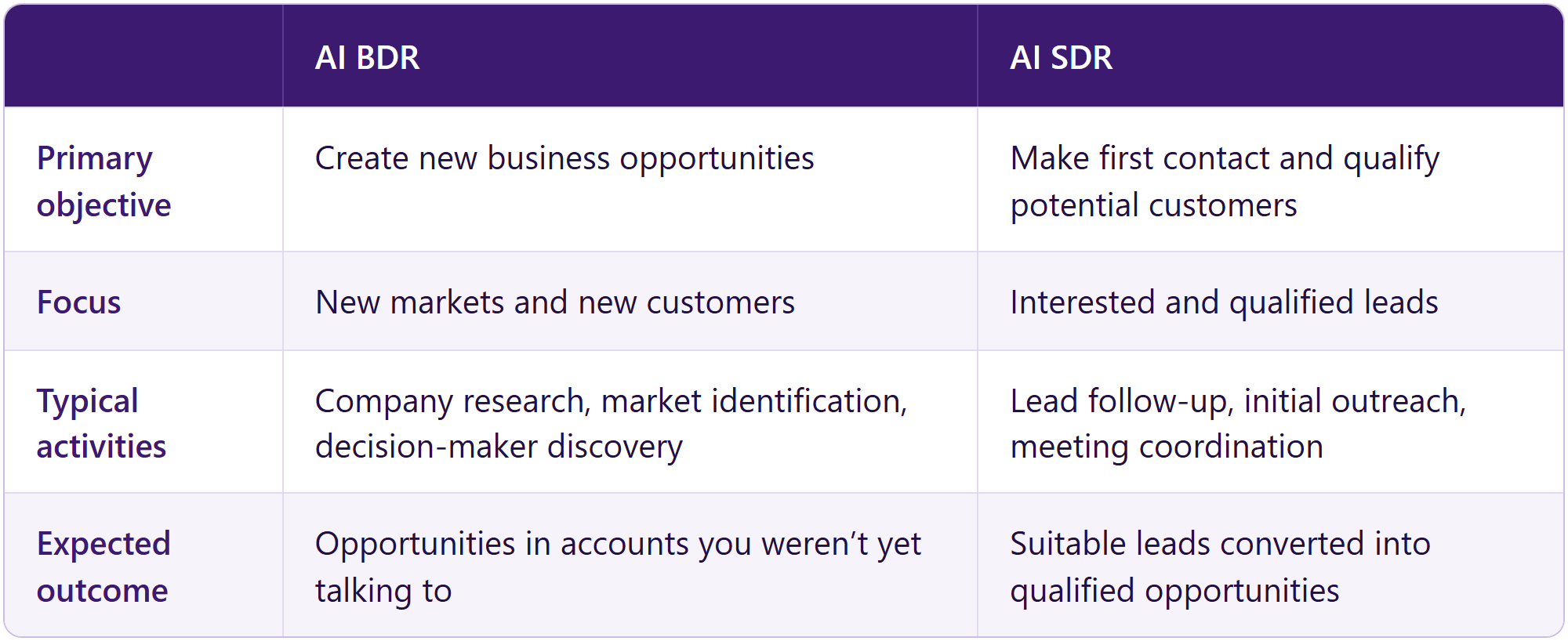
In practice the roles overlap. What matters is that an AI BDR is not just a tool for sending automated emails. It should be part of a process for finding and creating the right opportunities.
2. How an AI BDR Works
An effective AI BDR runs six connected steps:
- Define the Ideal Customer Profile (ICP). Decide what kind of company suits your business. For an engineering consultancy, that might be companies in construction, mining or infrastructure that run large, complex projects, need specialist engineering services and have the budget to buy them. AI can gather and analyse company data, but the criteria must reflect your actual strategy.
- Identify buying signals. Look for events that suggest a need: entering a new market, starting a major project, hiring for a specialist role or appointing a new executive. Not every signal means a company is ready to buy, so judge each one for relevance and source reliability.
- Find the decision-makers. Identify the people who make or influence the purchase, such as the CEO, the business development director, or operations, project and technical managers. The goal is not just a name and email address, but knowing who is most relevant and why.
- Prepare personalised messages. Instead of a general pitch about engineering services, refer to a specific project or need. AI can summarise company information, link the prospect’s needs to your services and draft messages, but every fact must be checked before anything is sent.
- Reach out and follow up. The AI can suggest when to follow up and which accounts need attention. The number of messages sent is not a measure of success: reaching the wrong people at the wrong time achieves nothing.
- Learn from the results. Track which companies respond, which signals lead to real opportunities and which contacts start useful conversations. Feed that back into your ICP, priorities and messaging.
3. What the Research Says
The most useful data comes from the 2026 State of the BDR report by 6sense and MarketOne, a survey of 872 BDRs. Most respondents work in software and technology, so the findings may not apply equally to every industry, and they show associations rather than proof of cause and effect.
AI use is almost universal, and outreach volume is rising. Reported AI adoption among BDRs rose from 53% in 2024 to 62% in 2025 and 99% in 2026. Touches per contact roughly doubled over the same period, from about 17 to 34. But more outreach did not reliably mean better performance.
How AI is used matters more than whether it is used.
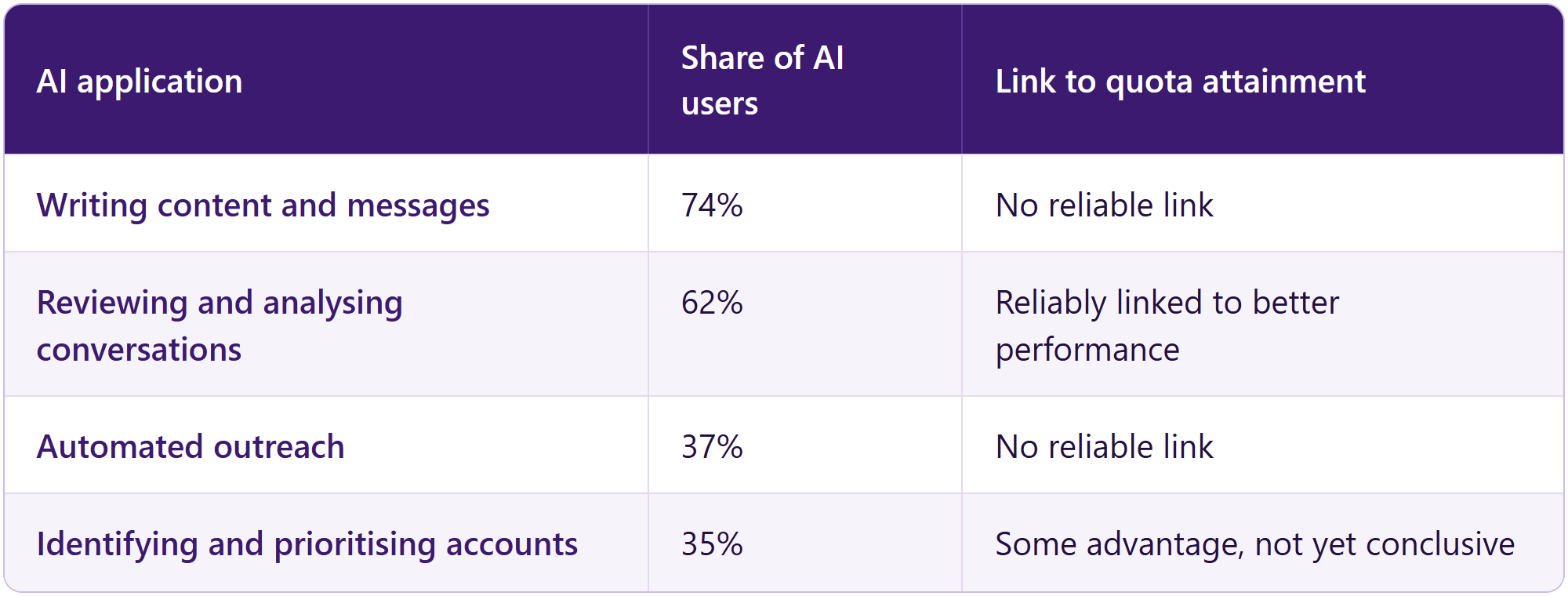
Having intent data is not the same as using it. About 90% of respondents said their organisation uses tools to identify accounts likely to be buying. Only 2% said those tools decide which accounts the team works, and only 19% said they trigger when outreach begins.
Timing is a leading reason prospects say no. 78% named wrong timing as one of the two top reasons for rejection. Among organisations that prioritise in-market accounts and target them differently, the figure was 44%.
Reaching more of the buying group helps. Reaching two additional people per account was associated with about 11 percentage points higher quota attainment. In B2B, one person may spot the need, another approve the budget and a third choose the supplier.
4. How to Roll Out an AI BDR
You don’t need to automate everything at once. Start with a limited process you can measure and improve:
- Start with one target market. An engineering consultancy might begin with infrastructure and mining companies only, using the ICP and signals from section 2.
- Set data quality and compliance rules. Verify company and contact details, and check privacy and marketing requirements before any outreach (see section 6).
- Run a small pilot. Work a limited set of accounts and measure how many truly fit the ICP, how many relevant contacts were found and how many qualified conversations followed.
- Complete the handoff. Record whether each prospect is qualified, what they need, what was discussed, the goal of the next meeting and who owns the follow-up. Only 36% of BDRs in the 2026 research completed the full handoff sequence.
- Scale on evidence. Expand to more accounts only when the pilot produces quality opportunities, not just more messages.
5. Metrics That Matter
Look beyond emails sent and meetings booked:
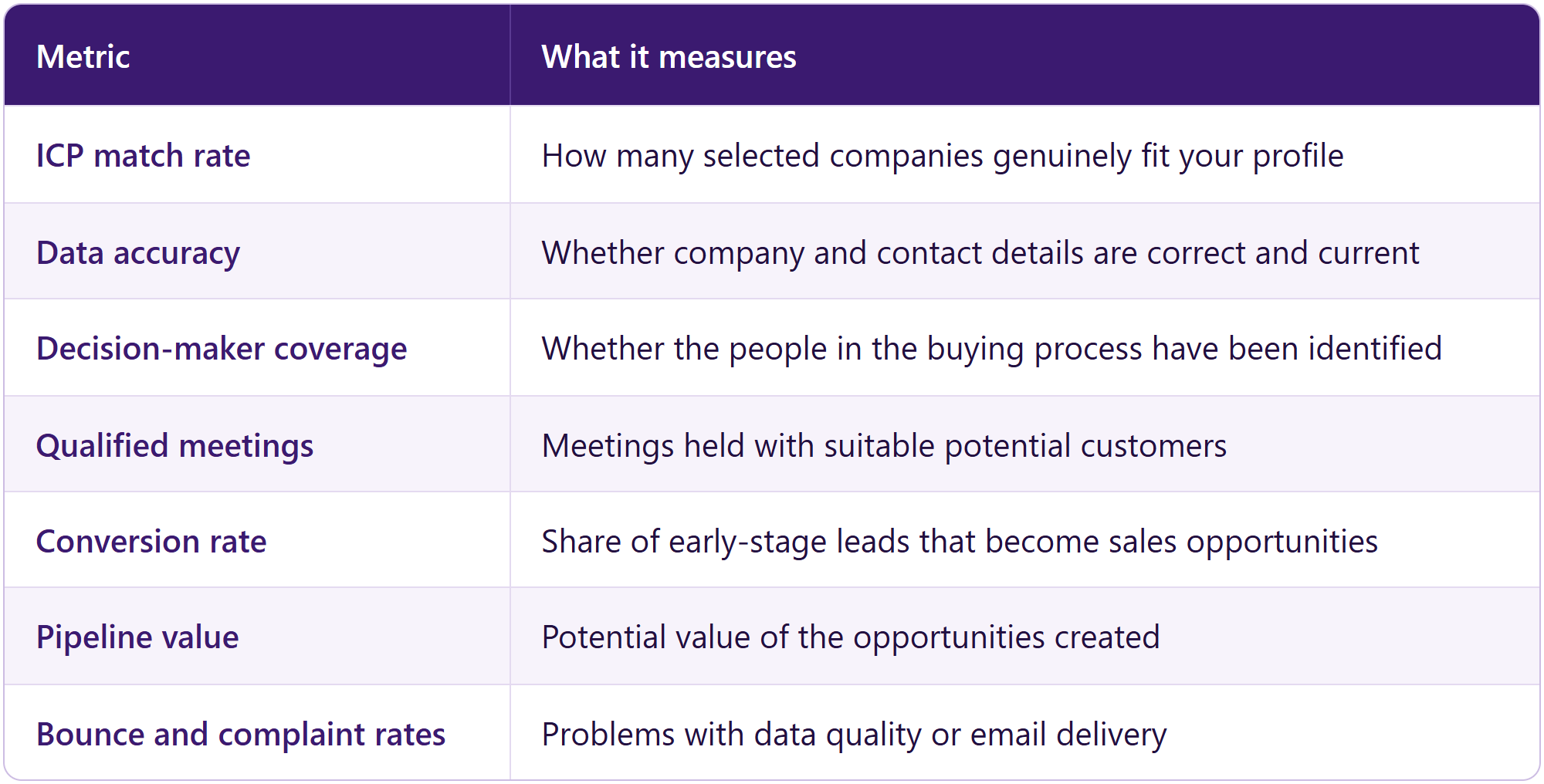
Choose metrics to fit your sales model. For a specialist consultancy that wins a few high-value contracts, the quality and value of opportunities matter far more than the number of replies.
6. Risks and Compliance
Without the right controls, an AI BDR can cause harm at scale:
- Poor data. Outdated or inaccurate information leads to messages reaching the wrong people, or incorrect claims about a company.
- Superficial personalisation. Adding a company’s name to a generic message isn’t personalisation. Each message needs a clear, relevant reason to get in touch.
- Sender reputation. Irrelevant messages in bulk raise complaints and hurt deliverability. Google’s email sender guidelines require authentication such as SPF and DKIM, and bulk senders also need DMARC and one-click unsubscribe.
- Australian compliance. Commercial messages must meet the Spam Act 2003: you need consent (express, or inferred in some circumstances), must identify yourself and must offer a working unsubscribe. Personal information must be handled in line with the Privacy Act 1988.
A publicly available email address is not, by itself, permission to send marketing email. Build compliance into the system from the start, not as a final check.
7. The Role of GTM Engineering
An AI BDR creates the most value as part of a connected go-to-market (GTM) system. GTM Engineering designs and connects the data, processes and automation behind sales and marketing, so that each step in section 2 feeds the next and results flow back into better targeting. In that system, the AI BDR is not an isolated tool. It turns reliable data into better decisions, and better decisions into higher-quality opportunities.
Conclusion: Better Outreach, Not More Outreach
AI is changing how companies find customers, but the research is clear: more AI and more activity don’t guarantee more sales. An effective AI BDR should help you answer a few fundamental questions:
- Which companies are the right fit, and why?
- What suggests now is the right time to contact them?
- Who should we speak to, and what value can we offer?
- How will we measure the results?
At AI Point, we help B2B teams build the GTM foundations behind those answers: the right customer profile, reliable account data and meaningful buying signals. If you’re considering an AI BDR, get in touch and we’ll help you design a pilot you can measure.
The goal is not more outbound activity. It is more meaningful connections with the right customers, at the right time, for the right reasons.
Sources
- 6sense and MarketOne, What 872 BDRs told us about performance in 2026
- 6sense, 2026 State of the BDR report: press release
- Google, Email sender guidelines
- Australian Communications and Media Authority, Avoid sending spam
- Office of the Australian Information Commissioner, The Privacy Act
Related Blog
Ready for your
next market?