
What Is Signal-Based Prospecting? A Complete Guide for B2B Sales

Every sales team has heard the advice:
"Send more emails."
"Make more calls."
"Increase your outreach volume."
But after running thousands of outbound campaigns, we've learned something different.
Volume isn't the biggest driver of success. Timing is.
The highest-performing campaigns don't simply reach the right person.
They reach the right person, at the right time, with the right message, backed by the right context.
That's what we call Signal-Based Prospecting.
What is Signal-Based Prospecting?
Signal-Based Prospecting is the practice of identifying events, behaviours, or changes that indicate a prospect is more likely to buy or consider change.
Instead of asking:
"Who matches our ICP?"
You ask:
"Who is most likely to need our solution today?"
That's a completely different approach.
The Four Elements of Great Outreach
Successful outbound happens when these four things align.
Right Person
        +
Right Time
        +
Right Message
        +
Right Context
        =
Higher Response Rates
Miss one of these, and engagement drops dramatically.
What Exactly Is a Signal?
A signal is any piece of information that increases the probability that someone is ready for a conversation.
Not all signals are created equal.
Some indicate urgency.
Others simply improve relevance.
Different Types of Signals
1. Company Signals
These are events happening inside a business.
Examples include:
- Hiring salespeople
- Hiring marketers
- Opening a new office
- Expanding internationally
- Raising funding
- Acquiring another company
- Mergers
- Leadership changes
- Product launches
- Website redesign
- Pricing changes
- New partnerships
- IPO announcements
These usually suggest growth or transformation.
2. Technology Signals
Technology changes often create opportunities.
Examples:
- Migrating from Salesforce to HubSpot
- Moving to Microsoft 365
- Adopting AI tools
- Launching a new CRM
- Switching marketing automation
- Replacing legacy systems
- Cloud migration
- Website migration
- Using a competitor's product
Technology transitions create uncertainty.
Uncertainty creates buying opportunities.
3. Behavioural Signals
These come directly from prospect activity.
Examples:
- Visiting your pricing page
- Downloading a guide
- Registering for a webinar
- Opening multiple emails
- Watching product demos
- Returning to your website
- Engaging with LinkedIn posts
- Following your company
- Requesting documentation
These are often the strongest buying signals because the prospect initiated the behaviour.
4. Buying Intent Signals
Some platforms aggregate intent from across the internet.
Examples:
- Searching for CRM software
- Reading AI automation articles
- Comparing competitors
- Researching pricing
- Looking for implementation partners
- Reviewing software categories
These usually indicate active research.
5. Industry Signals
Sometimes the opportunity isn't inside the company.
It's happening across the entire industry.
Examples include:
- New government regulations
- Compliance deadlines
- Interest rate changes
- Insurance reforms
- Privacy legislation
- Cybersecurity mandates
- Economic changes
- Industry reports
- Competitor announcements
One industry event can suddenly make thousands of businesses potential buyers.
6. Seasonal Signals
These are predictable events that affect business priorities.
Examples:
- End of Financial Year
- Beginning of Financial Year
- End of Quarter
- New Financial Year planning
- Budget approvals
- Annual planning cycles
- Holiday staffing
- Tax season
These absolutely count as signals.
They're simply predictable signals.
For example:
An accountant in April has very different priorities than an accountant in October.
7. External Market Triggers
This is where people often get confused.
Is a major news story a signal?
Yes, but more accurately, it's a market trigger that creates new signals.
For example:
OpenAI releases a new AI model.
Microsoft launches Copilot.
Google changes search rankings.
A new privacy law is introduced.
These aren't signals from an individual prospect.
They're external events that increase the likelihood that many businesses will need to act.
A trigger changes market conditions.
The resulting company responses become the signals.
For example:
OpenAI launches a major model
            ↓
Companies begin AI initiatives
            ↓
Hiring AI staff
            ↓
Searching for consultants
            ↓
Signal appears
Trigger vs Signal
Many people use these interchangeably.
We don't.
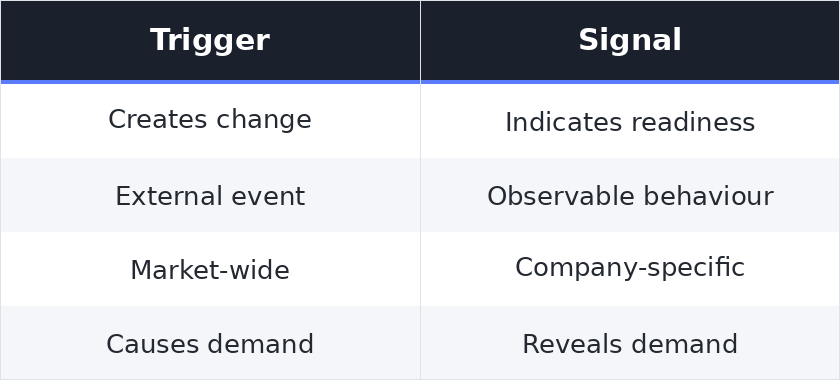
For example:
Trigger
New cybersecurity legislation announced.
Signal
Company starts hiring security engineers.
Another example:
Trigger
Microsoft announces Copilot.
Signal
Company begins migrating to Microsoft 365.
Why Signals Matter
The signal based approach feels relevant instead of random.
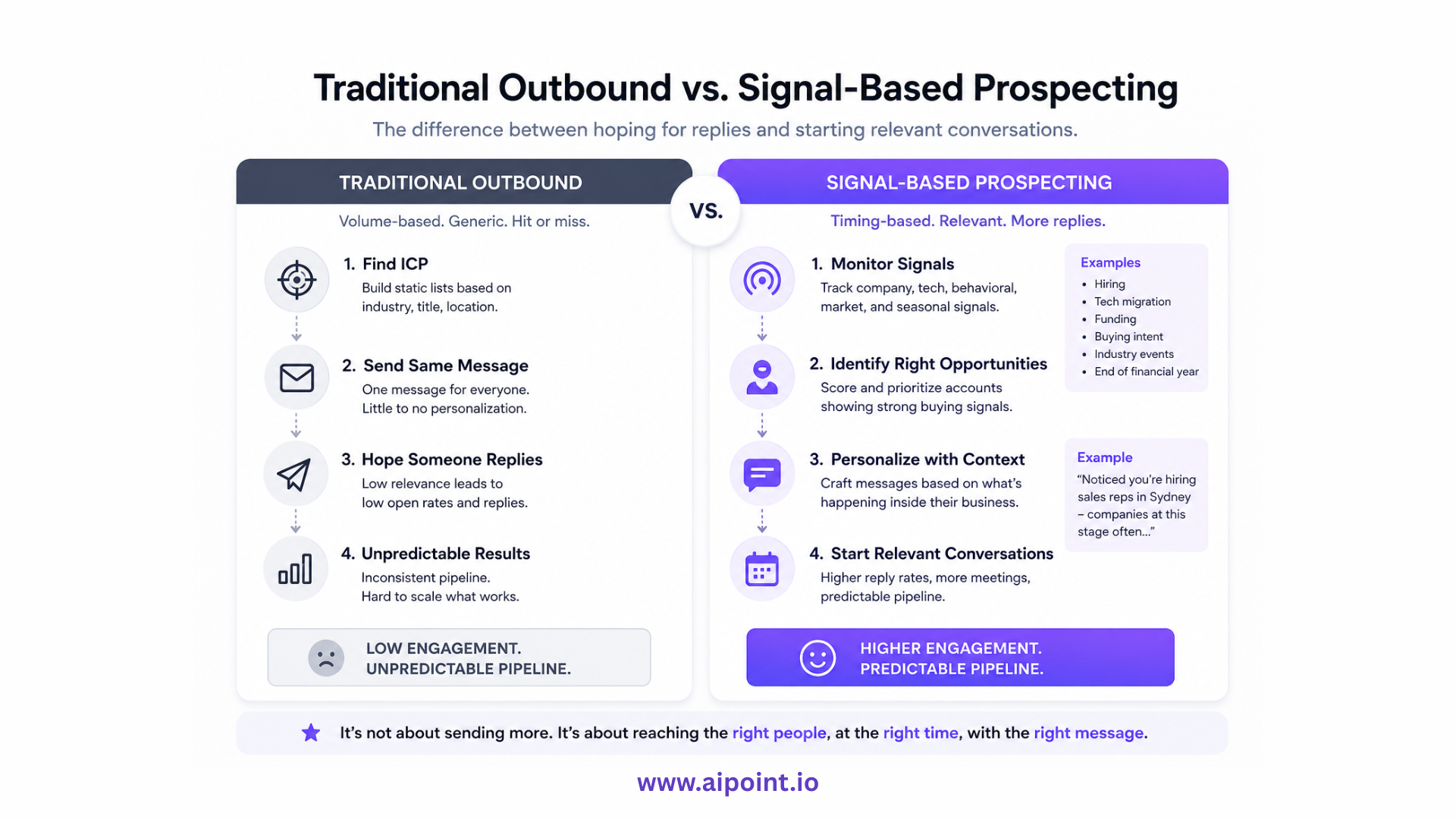
The Best Outreach Starts With Context
Compare these two emails.
Traditional
We help companies automate sales with AI. Would you like a demo?
Now compare it to this.
Signal-Based
I noticed you're expanding your sales team across Australia. Companies at this stage often struggle to maintain consistent pipeline generation while new reps ramp up. We've helped similar businesses use AI to generate qualified meetings before additional hiring is needed.
Same product.
Different context.
Much higher relevance.
Where Do Signals Come From?
Signals can be collected from many sources:
- LinkedIn activity
- Company websites
- Job boards
- Technology tracking platforms
- Funding databases
- Government announcements
- Industry news
- CRM activity
- Website analytics
- Product usage
- Search intent platforms
- Public APIs
- Internal customer data
Modern AI workflows can continuously monitor these sources and surface opportunities automatically.
Building a Signal Pipeline
At AI Point, we've found that successful outbound isn't about sending more messages—it's about identifying the right opportunities before everyone else.
A signal-based workflow typically looks like this:
Monitor hundreds of data sources
            ↓
Detect relevant business signals
            ↓
Score opportunities
            ↓
Enrich decision makers
            ↓
Generate AI-personalised messaging
            ↓
Launch omnichannel outreach
            ↓
Continuously monitor for new signals
Instead of treating every prospect equally, you prioritise those most likely to engage today.
Introducing the Signal Pipeline System™
Over the years, we've refined our approach into a repeatable framework we call The Signal Pipeline System™.
It's designed to help B2B businesses identify prospects at the moment they're most likely to engage, instead of relying on static lead lists or generic outreach.
The framework consists of four stages:
1. Detect
Continuously monitor company, technology, behavioural, market, and seasonal signals across hundreds of data sources.
2. Prioritise
Score and rank opportunities based on signal strength, buying intent, and alignment with your ideal customer profile.
3. Personalise
Use the signal as context to generate highly relevant messaging that speaks to what's happening inside the prospect's business today.
4. Engage
Execute coordinated outreach across LinkedIn, email, voice AI, and SMS, while continuously adapting based on engagement and new signals.
Instead of asking, "Who should we contact?", the Signal Pipeline System answers a much more valuable question:
Who is most likely to need our solution today?
That's the difference between traditional outbound and signal-based prospecting. Rather than interrupting prospects with generic messages, you start conversations that are timely, relevant, and far more likely to receive a response.
Final Thoughts
The future of outbound isn't about sending more emails.
It's about recognising when someone is most likely to care.
Signals help you understand timing.
Context makes your outreach relevant.
AI makes the process scalable.
When you combine all three, outbound stops feeling cold—and starts feeling helpful.
Because the best sales conversations don't begin with a pitch.
They begin at exactly the right moment.
Related Blog


Ready for your
next market?