
CRM Optimisation for Australian B2B Companies: How to Turn Stale Data into Revenue (2026)

The Scale of the Problem
B2B contact data decays at approximately 22.5% per year. In high-turnover sectors like SaaS and tech, that rate can reach 70%. In plain terms: if your CRM has 5,000 contacts and you haven't enriched the data in two years, more than 1,000 of those records are wrong.
Wrong means:
- Emails that bounce (damaging your domain reputation)
- Job titles that are outdated (messaging the wrong person)
- Phone numbers that don't connect
- Company records that have merged, rebranded, or closed
A 2025 Validity survey found that 37% of CRM users reported losing revenue directly due to poor data quality. The problem isn't that Australian businesses don't have leads — it's that the leads they have are invisible because the data underneath them is broken.
What CRM Optimisation Actually Means
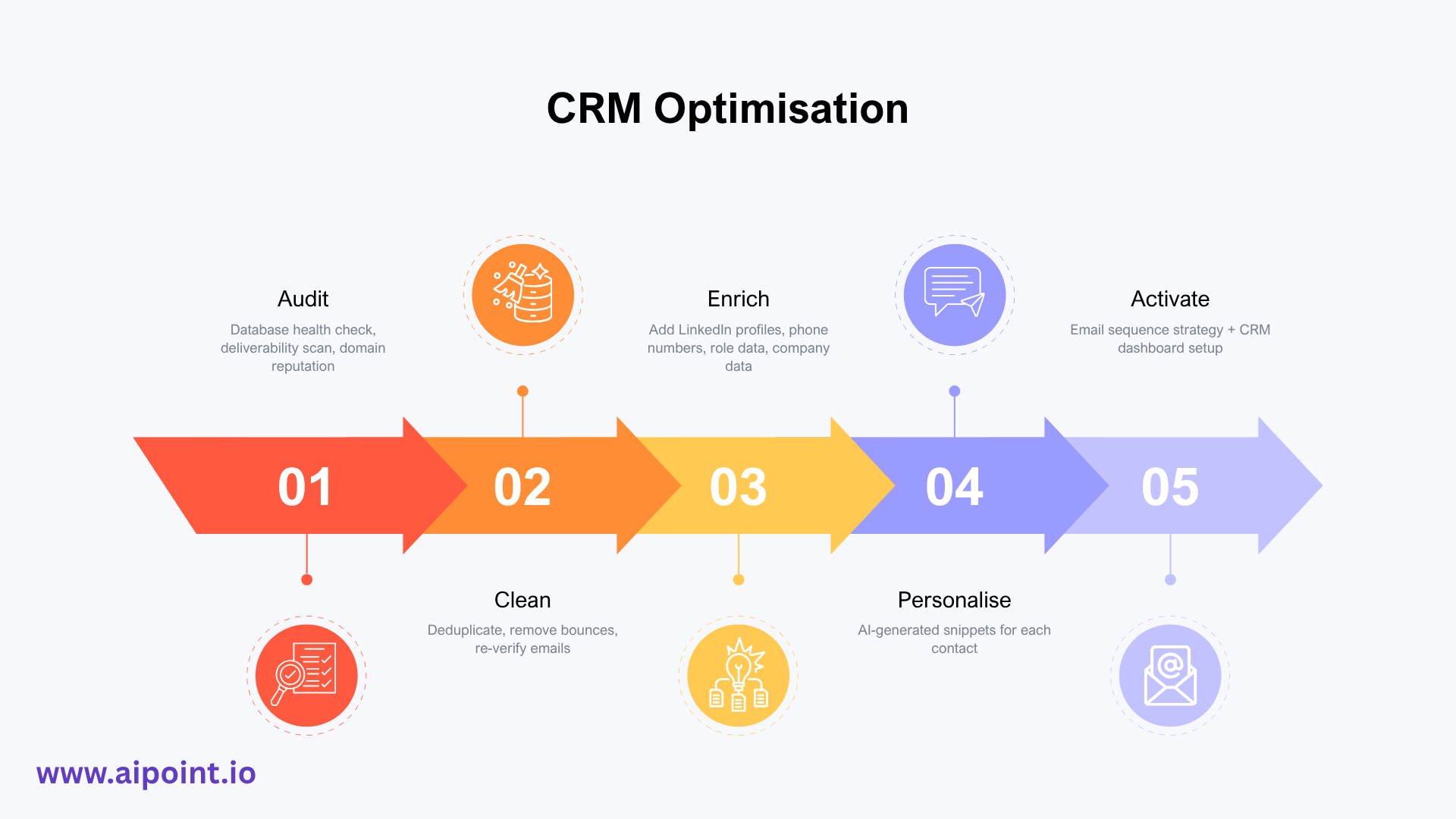
CRM optimisation isn't just cleaning a spreadsheet. In 2026 it covers five interconnected areas:
1. Data Cleaning and Deduplication
Remove duplicate records, standardise formatting, merge incomplete entries. A CRM with 8,000 contacts often has 1,500+ duplicates created by manual entry, form submissions, and import errors. Duplicates mean your team contacts the same person twice — or worse, two reps work the same account without knowing it.
2. Data Enrichment
Enrich existing contacts with current information — verified email addresses, direct phone numbers, updated job titles, LinkedIn profiles, company size, revenue range, and technology stack. The best enrichment approach in 2026 is waterfall enrichment — querying multiple data sources in sequence until a verified match is found. A single data provider typically leaves 40-60% of contacts unreachable. Waterfall reduces that to under 10%.
3. Buying Signal Integration
This is where 2026 CRM optimisation diverges from traditional database cleanup. Beyond static contact data, you can now enrich records with intent signals — has this company recently raised funding? Are they hiring in sales or marketing? Have they changed their tech stack? Has a decision-maker recently moved into a new role?
These signals tell you which dormant contacts in your CRM are ready to hear from you right now — turning a cold database into a warm prospect list.
4. Email Infrastructure and Deliverability
This is the most overlooked part of CRM optimisation — and the most expensive to ignore. If your main sending domain has been used for bulk email campaigns, there's a good chance your deliverability is compromised. Signs include:
- Emails landing in spam folders
- Open rates below 15%
- Bounce rates above 3%
- Domains blacklisted by major providers
Fixing this requires a full infrastructure audit: domain health check, SPF/DKIM/DMARC configuration, dedicated sending domain setup, inbox warmup, and deliverability monitoring. Until this is fixed, no amount of great copy or enriched data will save your campaigns.
5. AI Copilot Integration
The final layer — deploying AI assistants inside your CRM that surface the right next action for each contact. Instead of a rep manually reviewing 200 records to decide who to call today, an AI copilot surfaces the five contacts showing buying signals, drafts a personalised message for each, and logs the outcome automatically. This is now available natively in HubSpot, Salesforce, and Attio — and it's the difference between a CRM your team uses and one they work around.
Who Needs CRM Optimisation in Australia
The businesses that benefit most are those with large existing databases and no internal RevOps or marketing operations function. In our experience working with Australian B2B companies, the highest-pain segments are:
Mortgage brokers — databases full of past clients, referral partners, and comparison site leads. 30-90 day sales cycles mean follow-up is critical, but most brokers have no automated nurture system. A well-enriched, well-structured CRM with automated follow-up sequences can reactivate leads that were written off months ago.
Industrial and wholesale businesses — often have 5,000-20,000 contacts accumulated over years of trade show attendance, phone-based sales, and manual entry. Email bounce rates of 20-30% are common. The database exists; the infrastructure to use it doesn't.
Consulting firms and agencies — past clients, past prospects, and network contacts all sitting in a CRM nobody trusts. No lead scoring, no stage tracking, no reactivation sequences.
Immigration and education consultants — long sales cycles (often months), WhatsApp-heavy communication, no unified pipeline view. Contacts get lost between WhatsApp, email, and spreadsheets.
The ROI of Getting This Right
A properly optimised CRM with working infrastructure, enriched data, and AI-assisted follow-up typically delivers:
- Email bounce rate drops from 10-20% to under 3% — protecting domain reputation and inbox placement
- 20-40% of dormant contacts reactivated within the first campaign post-enrichment
- Reply rates 2-3x higher on enriched, signal-triggered outreach vs generic broadcast emails
- Sales team productivity increases — reps spend time selling, not researching and data entry
For a business with 5,000+ contacts that hasn't run a proper CRM campaign in 12+ months, one reactivation campaign to a cleaned, enriched database often pays for the entire optimisation project.
What the Process Looks Like
A typical CRM optimisation project for an Australian B2B business runs over 4-6 weeks:
Week 1-2: Audit — database analysis, domain health check, deliverability assessment, duplicate identificationWeek 2-3: Clean — deduplication, data standardisation, invalid record removalWeek 3-4: Enrich — waterfall enrichment across multiple sources, buying signal overlay, LinkedIn profile matchingWeek 4-5: Infrastructure — dedicated sending domain setup, warmup, DMARC/SPF/DKIM configuration, CRM dashboard and reporting setupWeek 5-6: Deploy — email sequence strategy, AI copilot integration, first reactivation campaign launch
The Bottom Line
Your CRM isn't the problem. The data inside it is. Australian B2B businesses that invest in CRM optimisation before running outreach campaigns see dramatically better results — because they're working with contacts that are real, current, and showing signals of readiness.
If your database has more than 1,000 contacts and your last email campaign had a bounce rate above 5%, it's time for an audit.
Book a CRM audit with AIPoint — we'll tell you exactly what's broken and what it would take to fix it.
Related Blog

Ready to Build
Your Pipeline?