
Prospeo vs Claude Code: Which Approach Builds a Better B2B Prospect List?

Introduction
Building a prospect list is slow. Someone has to decide which companies fit, find the right people, check their details and make sure the emails will actually arrive. Done by hand, it can take days.
This is where an AI agent such as Claude Code can help. Connected to a data platform like Prospeo, it can search for companies, pull contacts, verify emails and flag likely mismatches.
But is an AI-built list actually better than one built by hand? We ran a small test to find out. We built one list manually in Prospeo and another with Claude Code, both for the same Ideal Customer Profile (ICP). We then compared them using local files only, with no extra Prospeo calls and no credits spent on the comparison itself.
1. The Test
Both lists were built for the same ICP. The manual list was built by searching and exporting in Prospeo. The Claude Code list was built by Claude Code, working with AIPoint's list-building and Prospeo research process, under a fixed credit cap.
2. The Results
A usable contact is a verified email at a suitable or probably suitable company. Fit labels are our own review, and the manual list's credit cost is an estimate because it is not recorded in the export.
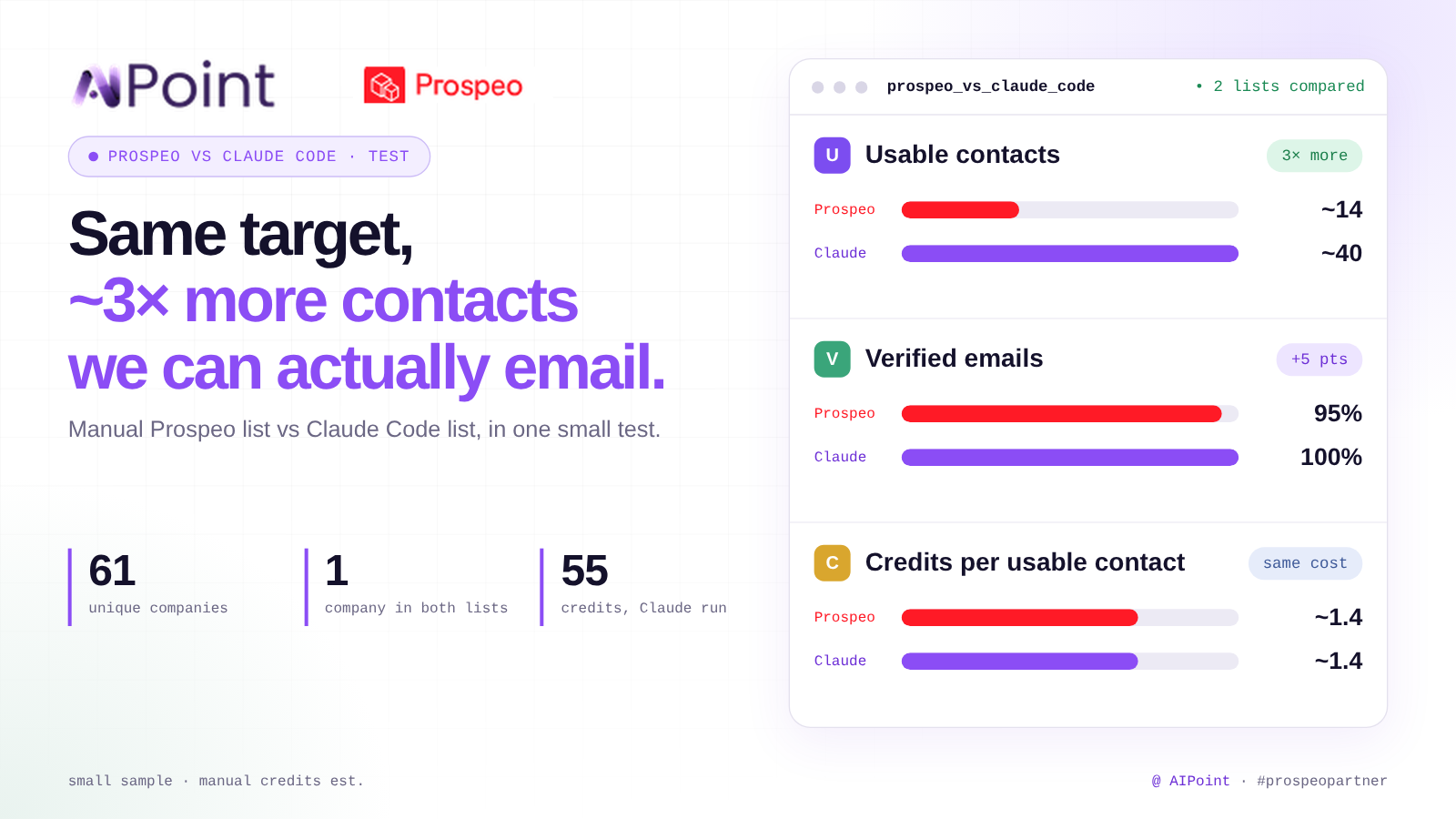
In this test, Claude Code produced about three times as many usable contacts, at a similar estimated cost per usable contact.
3. What We Found
Claude Code produced a larger, cleaner list. All 50 of its contacts had verified emails, against 19 of 20 in the manual list. It still needed human review: around 10 companies looked like agencies or service firms, and a few domain and job-title mismatches had to be checked. AI makes prospecting faster, but human validation stays important.
The real difference was usable contacts. Claude Code gave about 40 contacts we could use for outreach, against about 14 from the manual list. The total number of contacts matters less than the number you can actually contact.
Cost was similar. Claude Code used 55 Prospeo credits and the manual list an estimated 19, which works out to about 1.4 credits per usable contact for both. The advantage is not a lower price. It is covering more prospects for similar spend.
The lists barely overlap. Across both lists there were 61 unique companies, and only one appeared in both. Each method found a different slice of the market, so the lists can be merged with almost no duplication.
4. Where Each Approach Is Stronger
Both lists fit the ICP at a similar level: in each, roughly four in five companies were suitable or probably suitable.
The Claude Code list had cleaner contact data (100% verified emails against 95%) and covered more companies, with one contact at nearly every company. Our review still flagged a few contacts whose current role needed checking.
The manual list came with company descriptions, which made it easier to judge company fit.
In short, Claude Code gave cleaner, more scalable contact data, while manual research gave richer company context. Used together, each covers the other's gaps.
5. What We Would Improve
- Lock your filters. Apply the same saved search settings to every export, so each pull starts from the same baseline and irrelevant results drop.
- Add company descriptions. They help identify agencies and generic service providers, and make both automated filtering and human review easier.
- Check data freshness. Before outreach, check each contact's current title, company, LinkedIn profile, company status and email validity, and remove companies that have changed ownership.
6. Limitations
This was one small test, not a formal benchmark.
- The lists were different sizes (20 and 50 people), so treat the three-times figure as indicative.
- "Suitable" and "probably suitable" are our own judgements, because the exports have no company description column.
- The manual list's credit cost is an estimate, since it is not recorded in the export.
- We measured list quality, not outreach results. Replies and meetings are the real test.
7. Responsible Outreach
A list is not permission to send. Before any outreach:
- Check the list against your suppression lists: clients, open deals, partners, competitors and unsubscribes.
- Confirm you have a lawful basis to contact each person under the email marketing and privacy rules that apply to you.
- Identify yourself in every message and offer a working unsubscribe.
This is general guidance, not legal advice.
Conclusion: Better Lists, Not Just Bigger Ones
In this small test, AI-assisted prospecting noticeably improved the efficiency of list building. That does not mean Claude Code should replace Prospeo or human review. The strongest approach combines all three: Claude Code for research, analysis and list-building logic; Prospeo for prospect data and email verification; and human review to make sure the final contacts match the ICP and are appropriate for outreach.
At AIPoint, we help B2B teams build the go-to-market foundations behind lists like these: a clear customer profile, reliable account data and a repeatable process. If you are considering AI-assisted prospecting, get in touch and we will help you design a pilot you can measure.
The goal is not the biggest prospect list. It is the most relevant and usable one.
Source: AIPoint internal comparison of two prospect lists, November 2026. Figures come from one small test.
Related Blog


Ready to reach
new buyers?