
What Is Signal-Based Prospecting — And Why It Outperforms Spray and Pray

The Problem With Spray and Pray
Traditional prospecting works like this: build a list of companies that match your ICP (industry, company size, job title), upload it to an outreach tool, and send the same sequence to everyone.
The logic is volume-based. If 10,000 people get your email and 2% reply, that's 200 conversations. Enough data points to work with.
The problems with this model in 2026:
Volume is no longer a differentiator. The average B2B decision-maker receives 30-50 cold emails per week — up from 10-15 in 2022. Everyone is running volume-based outreach. Inboxes are saturated.
Generic outreach damages your domain. High bounce rates, low open rates, and spam complaints from recipients who don't recognise your name hurt your sender reputation — making every future email harder to deliver, even to warm prospects.
It burns prospects you could have closed later. A prospect who receives a generic email when they're not in-market doesn't think "I'll remember this for when I'm ready." They think "spam." You've permanently damaged your chance with them.
The numbers are collapsing. Cold email reply rates industry-wide dropped to 1-3% in 2026. That means 97-99 out of every 100 outreach touches produce nothing.
What Signal-Based Prospecting Means
Signal-based prospecting inverts the model. Instead of asking "who fits our ICP?" and contacting everyone, it asks "who fits our ICP and is showing signs of being in-market right now?"
A buying signal is any observable event that indicates a prospect is more likely than usual to be thinking about the problem you solve.
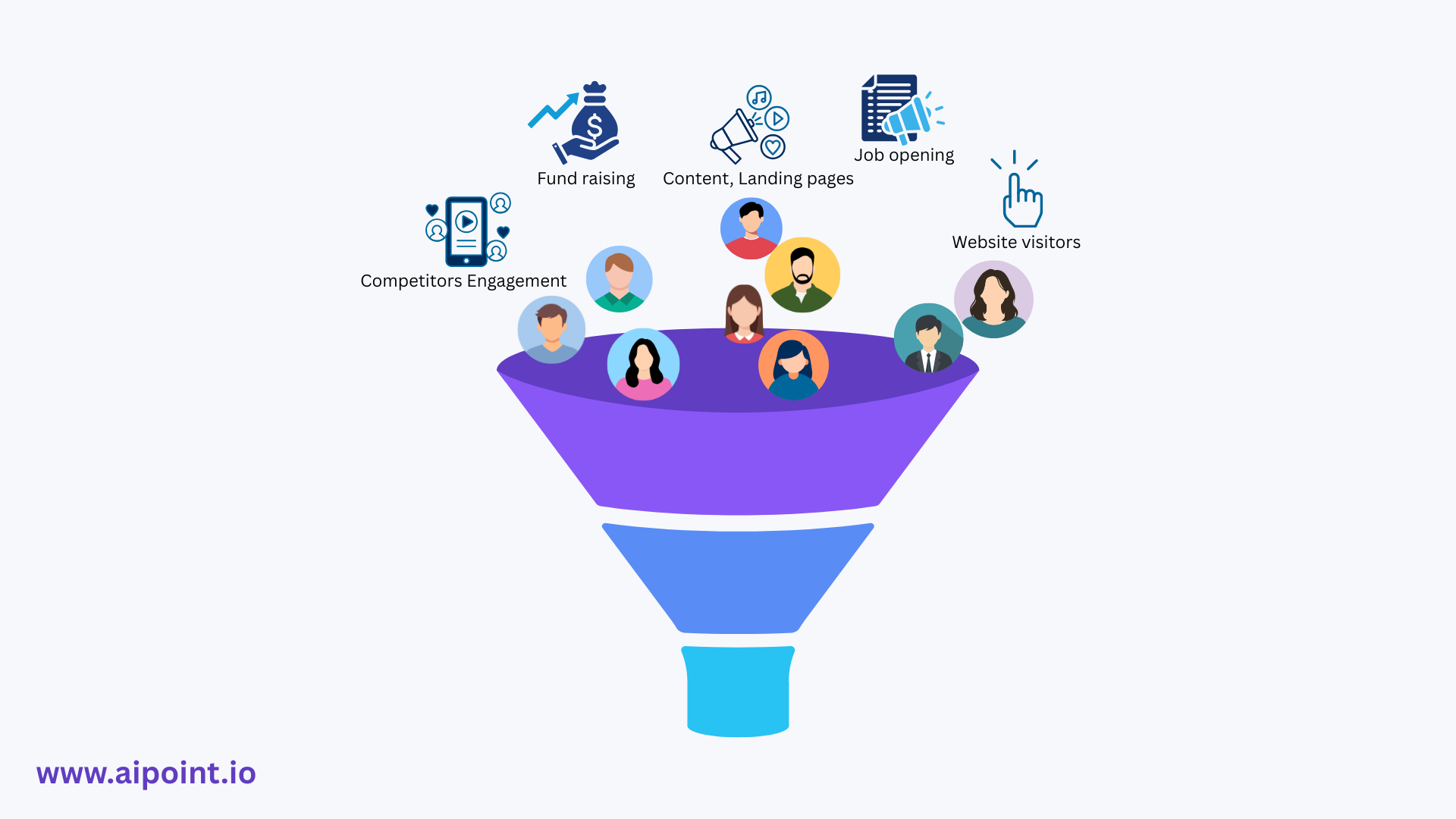
Signals come in several categories:
Intent Signals
Direct indicators of research and buying behaviour:
- Visiting specific pages on your website (pricing, case studies, comparison pages)
- Downloading content related to your category
- Engaging with competitor content on LinkedIn
- Searching for reviews of solutions like yours on G2 or Capterra
Firmographic Signals
Company-level events that indicate change and growth — the conditions under which new purchases happen:
- Funding announcements — a recently funded company is investing in infrastructure
- Hiring in specific roles — a company hiring multiple SDRs has a pipeline problem you can solve
- Leadership changes — a new Head of Sales has a mandate to fix what wasn't working under the previous person
- Company expansion — new office, new market, new product launch all signal growth mode
Technographic Signals
Changes to a company's tech stack that indicate a problem or a purchasing cycle:
- Switching CRMs — they're unhappy with the current one and actively evaluating
- Adding marketing automation — they're investing in pipeline
- Removing a competitor tool — there's a gap you could fill
Engagement Signals
Behavioural signals from LinkedIn and email:
- A prospect liked or commented on your content
- They viewed your LinkedIn profile
- They opened your previous email but didn't reply
- They clicked a link in a sequence but didn't respond
- A mutual connection recently connected with them
Contextual Signals (for Professional Services)
For mortgage brokers, financial advisors, and similar — the signals that indicate a personal financial event:
- New job or promotion (new income, new financial planning needs)
- Recently engaged or married
- Posting about property, investment, or major life decisions
- Company they work for recently raised funding (team likely receiving equity or bonuses)
The Performance Gap
The data is unambiguous. Signal-based prospecting outperforms spray-and-pray by every meaningful metric:
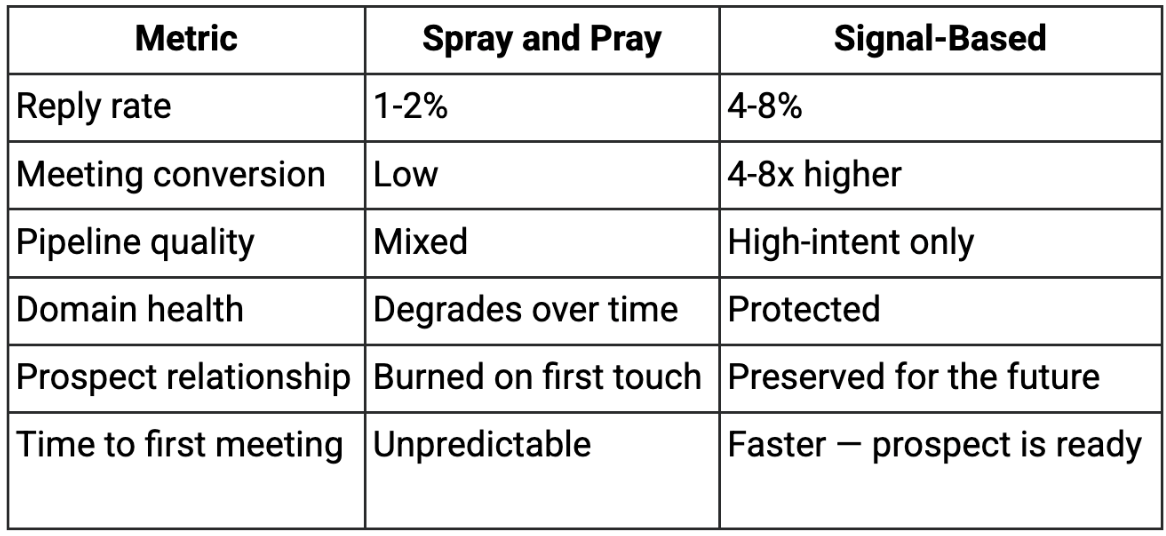
One documented case: Analytic Partners saw a 40% increase in qualified pipeline after switching to signal-based prospecting — with account research time dropping from 3 hours to 15 minutes per account.
For AIPoint's own client acquisition: LinkedIn outreach using signal-based targeting delivers a 1.7% meeting rate against 0.08% for generic email outreach — a 20x difference.
How Signal-Based Prospecting Works in Practice
Step 1: Define which signals matter for your ICP
Not every signal is relevant to every business. A mortgage broker cares about job changes and life events. A B2B SaaS company cares about hiring signals and funding rounds. A CRM consultant cares about tech stack changes and new leadership hires.
The first step is mapping which signals correlate with your best clients' buying behaviour — when did they become a prospect, and what was happening in their business at that time?
Step 2: Set up signal monitoring
Signals are monitored across multiple sources:
- LinkedIn (job changes, content engagement, company announcements)
- Crunchbase / Dealroom (funding rounds, acquisitions)
- Job boards (hiring patterns)
- News monitoring (press releases, company announcements)
- Email engagement data (opens, clicks, no-replies)
- Website visitor identification tools
Tools like Clay aggregate these signals from multiple sources and score prospects based on signal strength — so the highest-priority outreach always goes to the hottest prospects.
Step 3: Trigger outreach based on signal, not schedule
This is the key difference from traditional sequencing. Instead of "send email on day 1, follow up on day 5, LinkedIn message on day 10 regardless of what the prospect is doing," signal-based outreach triggers when the signal fires.
A prospect who just got promoted gets an outreach message this week — not because it's their turn in the sequence, but because the timing is right.
Step 4: Personalise the message to the signal
The signal becomes the reason for the outreach — making the message immediately relevant rather than generic.
Instead of:
"Hi [Name], I help companies like yours with B2B outbound..."
Signal-based:
"Hi [Name], noticed [Company] just expanded to Melbourne — congrats. At that stage of growth, building a scalable pipeline usually becomes the priority. Thought it was worth reaching out."
The prospect immediately knows why they received this message. It doesn't feel cold because it isn't cold — it's contextually relevant to something real that's happening in their business.
Step 5: Enrich and qualify before you reach out
Signal-based prospecting doesn't just identify who to contact — it enriches their data before the first touch. Verified email, LinkedIn profile, company data, decision-maker confirmation, and tech stack — all validated before a single message is sent.
This eliminates the bounce rates, wrong-person contacts, and irrelevant targeting that plague spray-and-pray campaigns.
Signal-Based Prospecting for Professional Services in Australia
For mortgage brokers, financial advisors, insurance brokers, and conveyancers in Australia, signal-based prospecting on LinkedIn is the highest-converting outbound approach available.
The signals that drive the strongest conversations:
- New job or promotion — income change, new financial planning needs
- Company funding — equity, bonuses, investment decisions
- Life events posted on LinkedIn — engagement, home purchase milestone content, family announcements
- Profile activity — viewing financial services content, following relevant accounts
These signals turn a cold connection request into a contextually relevant conversation. A financial advisor who reaches out to someone who just got promoted isn't cold-calling — they're relevant.
Why Most Businesses Don't Do This (Yet)
Signal-based prospecting requires infrastructure that most businesses don't have:
- Tools to monitor signals across multiple sources simultaneously (Clay, LinkedIn Sales Navigator, intent data platforms)
- Data enrichment pipelines to verify contact information before outreach
- AI to process signal data at scale and prioritise outreach
- Copywriting expertise to translate signals into relevant opening messages
- Technical setup to connect all these tools into one workflow
Building this from scratch takes weeks and requires expertise across data, automation, and copywriting. Running it ongoing requires consistent oversight and optimisation.
This is why the businesses that benefit most from signal-based prospecting either hire a specialist to build the system or work with an agency like AIPoint that already has the infrastructure in place.
The Bottom Line
Spray and pray had its moment. In 2026, it's a liability — burning prospects, damaging domain reputation, and producing diminishing returns. Signal-based prospecting isn't a tactical improvement on the same model. It's a fundamentally different approach that respects the prospect's time and earns the right to reach out.
The businesses winning at outbound in ANZ right now are not the ones sending the most messages. They're the ones sending the right message, to the right person, at the exact moment it's relevant.
Book a strategy call with AIPoint to see what a signal-based outbound system looks like for your market.
Related Blog

Ready to Build
Your Pipeline?