
Why Your Outbound Isn't Working (It's Not the Copy)

The Mistake Almost Every Team Makes
The default outbound process looks like this: build a list, enrich it, write personalised messages, send them, hope for replies. It feels logical. It's expensive and inefficient.
The problem is enrichment. Most teams enrich everyone — every company that matches the ICP filters, every job title on the target list. Then they wonder why reply rates are low and cost per meeting is high.
They blame the copy. They rewrite the subject line. They try a new framework. None of it helps, because the real issue is that they're spending money enriching and messaging people who will never convert — not because the message was wrong, but because the timing was wrong. The prospect wasn't in-market. Nothing changed in their world that made your offer relevant right now.
The fix is sequencing. Not better copy. A different order of operations.
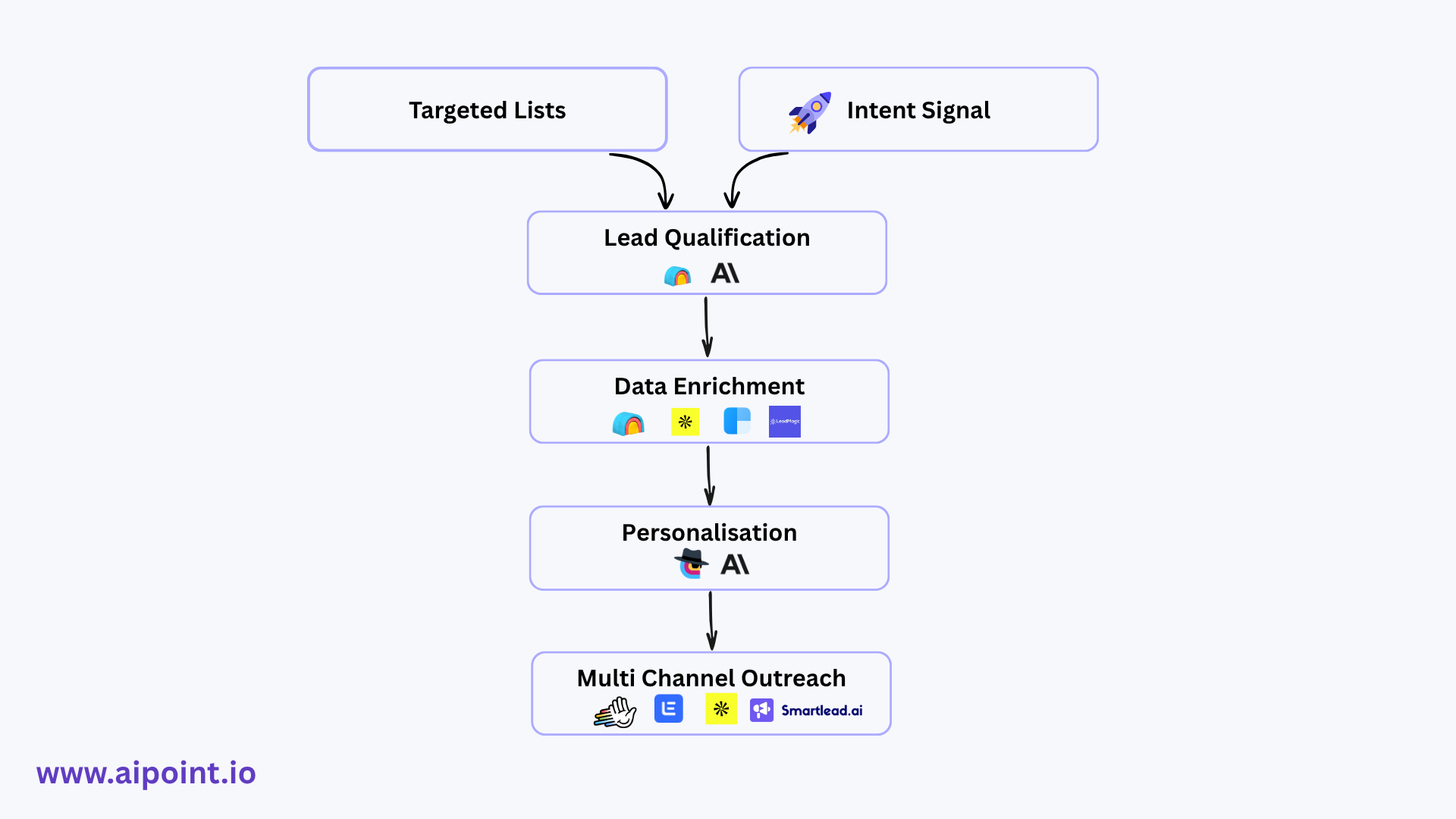
Signal → Qualify → Enrich → Personalise → Sequence
Five stages. A specific order. None of them optional.
Stage 1: Signal
The first question isn't "who fits my ICP?" It's "who fits my ICP and is showing signs of being in-market right now?"
A signal is evidence that something has changed. Change creates windows. A new VP of Sales has a new mandate and new budget. A company that just raised a Series A is actively investing in infrastructure. A business posting three SDR job openings has a pipeline problem they're already trying to solve. A company that just changed their CRM is in a buying cycle for adjacent tools.
These aren't hypothetical fits. These are companies where something real has happened that makes your outreach relevant this week, not in theory.
The output of this stage is a raw list of accounts showing at least one signal. No enrichment yet. No emails. Just accounts worth investigating.
Stage 2: Qualify
This is where most teams leak money — they skip straight from signals to enrichment.
Before spending a single enrichment credit, every account needs to pass a qualification filter. At AIPoint we score each account across five dimensions: company size, deal value fit, sales motion, signal strength, and geography. Maximum ten points. Anything below seven goes on a watch list or gets cut entirely.
In Clay, this is a formula column. The conditional logic is simple: if the score is seven or above, the row is marked Qualified and flows to the next stage. Everything below that threshold sits in a separate table, revisited in thirty days or discarded.
This single filter eliminates forty to sixty percent of wasted enrichment spend. It's not glamorous. It's the most financially important step in the entire process.
Stage 3: Enrich
Now — and only now — you enrich.
The right approach is a waterfall: multiple data providers queried in sequence, each one only firing if the previous returned nothing. At AIPoint we run Prospeo first (strongest coverage for LinkedIn-sourced leads and strong AU/NZ data), then Dropcontact, then LeadMagic for whatever the first two miss. Lusha for mobile numbers on priority accounts only.
Running providers in parallel wastes credits on duplicates. Sequential is the only way.
After enrichment, every contact gets verified before entering a sequence. NeverBounce or ZeroBounce. Unverified emails damage your domain reputation — one bad batch can tank deliverability for weeks. The target is eighty-five to ninety percent verified coverage on qualified contacts. Below seventy percent means the ICP filter in Stage 2 is too narrow.
Stage 4: Personalise
The goal of personalisation is simple: write a first line that proves you did real research, in one sentence, referencing the specific signal that triggered the outreach.
Not "Hi James, I came across your profile." Not a mail merge with their company name. A line that could only have been written for this person, at this moment, based on what's actually happening in their world.
The difference looks like this:
Generic: "Hi James, I came across your profile and wanted to reach out about how we help sales teams."
Signal-based: "Saw [Company] just brought on three new SDRs — curious how you're thinking about data quality and enrichment at that scale?"
The second line references the hiring signal, implies expertise in the problem that signal creates, and asks a question they'll actually think about. It earns a reply because it's relevant, not because it's clever.
At scale, we use a Claude Skill inside Clay to generate this automatically. The skill receives the contact's name, role, company, and the specific signal. It outputs three first-line variations, each referencing the signal differently. We review a sample before the campaign launches — AI writes fast, but quality control is still a human job.
Stage 5: Sequence
By the time a contact reaches this stage, three things should be true: they scored seven or above on ICP fit, their email is verified, and they have a personalised first line referencing a real buying signal.
The sequence itself is simple. Four touches. Email one on day zero — signal-triggered opener plus one clear question. Email two on day three — a different angle or a relevant insight. Email three on day seven — a short "still relevant?" bump. Email four on day fourteen — close the loop.
Under a hundred words per email for the first three touches. One idea per email. One CTA per email. No external links in the first two touches — they trigger spam filters before trust is built.
Domain setup is non-negotiable before any of this goes live. SPF, DKIM, and DMARC configured on every sending domain. Two-week warmup minimum. Secondary domains only for cold outreach — never your primary domain. With proper infrastructure and signal-based targeting, healthy benchmarks are four to ten percent reply rate, under three percent bounce rate, and under 0.1 percent spam complaints.
What Changes When You Do This Right
The math shifts. Instead of enriching a thousand contacts to get ten replies, you enrich two hundred qualified, signal-triggered contacts and get fifteen. Lower volume. Lower cost. Higher output.
More importantly, the conversations that result are different. A prospect who received a message because something real changed in their business is a different conversation from one who received a message because their job title matched a filter. The first one knows why you reached out. The second one doesn't.
That difference shows up in close rates, not just reply rates.
The Honest Version
This process works. It's the exact process I run for every AIPoint client campaign. It took six months of low reply rates and painful reflection to arrive at it.
If you want to build it yourself, everything you need is in this post.
If you'd rather have the full Clay table, waterfall logic, and Claude Skill configured for your specific ICP — book a free pipeline audit. We'll map your current outbound setup and show you exactly where it's leaking.
Related Blog


Ready to Build
Your Pipeline?