
AI Search Visibility: How to Get Your Brand Recommended by AI

Key Takeaways
- AI search visibility is how often your brand is named or linked in AI answers. Measure it with visibility, share of voice, position, sentiment, mentions and citations.
- Always split branded and unbranded prompts. An overall number can hide the gap: in the worked example, 96% on branded prompts but only 8% on unbranded ones.
- The strongest public evidence points to mentions on other sites plus clear, well-sourced content. Results are never guaranteed, so start with a baseline.
Introduction: When Ranking on Google Doesn't Mean Being in the Answer
Imagine a commercial leader at a B2B company. Their website ranks well on Google for "best business development partner in Australia". Then a prospect asks ChatGPT the same question and gets a written answer naming three brands. Theirs is not one of them.
The problem is not necessarily the website. It is that buyers now ask AI tools questions and get a short list of brands in the answer, and the old question "do we rank on Google?" no longer covers that.
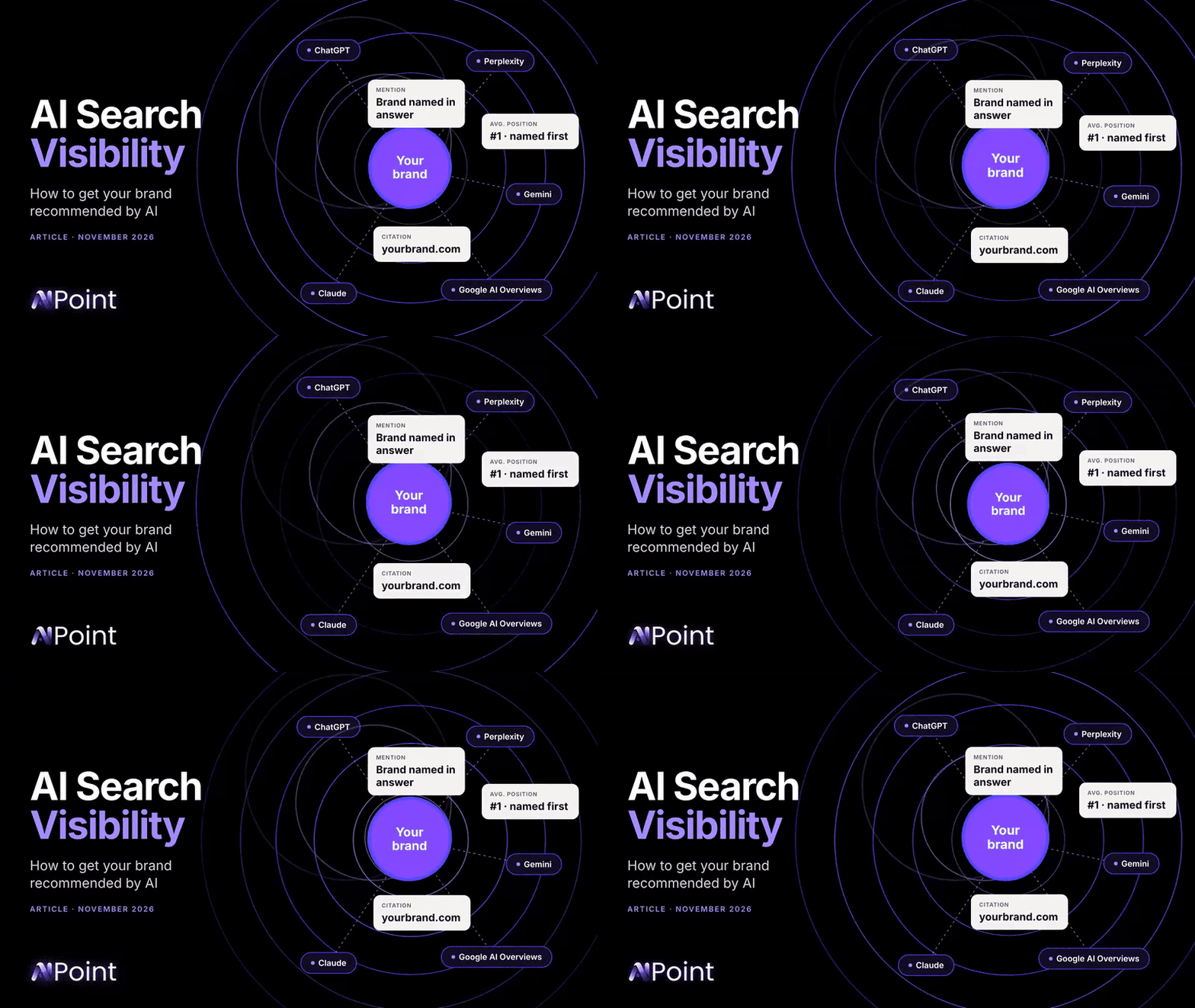
AI search visibility is how often, and how prominently, your brand appears in the answers that AI tools give: ChatGPT, Google AI Overviews, Perplexity and other AI search experiences. It is the AI-search version of "do we rank on Google?"
The real question is not whether a page ranks. It is whether your brand is one of the brands the AI names when a buyer asks.
Figures in this article come from public studies and vendor reports, linked under Sources and Further Reading. Check the date of every statistic, because these numbers change quickly. AI answers vary from run to run, and nobody can guarantee a result.
1. What Is AI Search Visibility?
Buyers now ask AI questions like "best business development partner in Australia" and get a written answer with a few brands in it. Visibility measures whether yours is one of them.
How Different Sources Define It
There is no single official definition yet. The main public ones agree on the idea (presence in AI answers) but differ on the detail:
- Salesforce: how often a brand appears in answers generated by AI engines such as ChatGPT, Claude, Gemini and Google AI Overviews.
- Similarweb: how often and how accurately a brand is mentioned, cited or recommended in AI answers. Unlike a Google ranking, it is close to yes or no: you are in the answer or you are not.
- Adobe: a percentage based on how often your brand is mentioned compared with the median number of mentions for competitors.
- Search Engine Land: a mention names your brand, while a citation links back to your content.
For example, two tools can report different "visibility" for the same brand, because one counts the share of answers that name you and the other compares you with competitors. Always check how a tool defines the number before comparing.
2. How AI Visibility Is Measured
These are the metrics most AI visibility tools report. Names and formulas vary between tools, so treat the examples as illustrations only.
- Visibility: The share of tracked AI answers that include your brand. Example: Your brand appears in 10 of 100 tracked answers: visibility is 10%.
- Share of Voice: Your share of all brand mentions, compared with competitors. Example: You get 10 of the 100 brand mentions across all brands: share of voice is 10%.
- Average Position: Where you appear in the answer (#1 is best). Example: Named first on average: #1.
- Sentiment: How positively the AI talks about you. Example: A higher score means a more positive tone.
- Mentions vs Citations: A mention names you. A citation links to your site. Example: "Brand X is a good option" is a mention. A clickable link to brandx.com is a citation.
Mentions and Citations
A mention is when an AI answer names your brand. A citation is when the answer links back to your content or website. Search Engine Land describes citations as a signal that the AI trusts your content enough to use it as a source. Similarweb adds that mentions tend to build awareness and shape buyer perception, while citations can drive referral traffic.
For example, "Brand X is a good option for engineering and industrial B2B firms" is a mention. The same sentence with a clickable link to brandx.com is a mention and a citation.
Branded and Unbranded Prompts
A branded prompt names your brand ("Is Brand X a good fit for a B2B company?"). An unbranded prompt asks about the category ("best business development partner in Australia"). Visibility is usually very different between the two: people who already know you will find you, but unbranded prompts are where new buyers are won or lost. Contentstack notes that AI visibility matters most for decision-stage questions, where the answer directly influences a purchase.
For example, "Is Brand X a good fit for a B2B company?" is branded, while "best business development partner in Australia" is unbranded. Track both, but expect the second to be harder.
Position Distribution
Position shows where you appear inside an answer: first, second, third and so on. Average position works like golf: a lower number is better, and #1 means you are named first.
Decision Journey
Some tools break prompts and visibility down by buying stage:
- Learn (top of the funnel, TOFU): people are researching and forming an opinion.
- Consider (middle, MOFU): people are comparing options.
- Purchase (bottom, BOFU): people are ready to choose.
Visibility is often lower in one stage than another. If a stage is weak, you may need more prompts or more content for it.
For example, a provider may appear when buyers ask "what is account-based marketing?" (Learn) but rarely when they ask "who can help our B2B company build an enterprise sales pipeline?" (Purchase). That tells you where to focus.
How to Read AI Visibility Data
AI visibility data is directional, not a fixed ranking. The same question can produce different answers depending on:
- Platform: ChatGPT, Gemini, Google AI Overviews, Perplexity and other AI search experiences use different models, indexes, retrieval systems and source preferences.
- Prompt wording: "Best business development partner for engineering firms in Australia" may produce a different answer from "how can an industrial B2B company build a predictable sales pipeline?"
- Location: Answers can vary by country, city and language. A buyer searching from Australia may receive different recommendations from someone asking the same question elsewhere.
- Date and repeated runs: AI answers change as models, web indexes, source material and product features change. One response is only a snapshot, which is why the same prompts should be tested repeatedly over time.
For a reliable baseline, track a consistent set of buyer questions, record the platform and location used, separate branded and unbranded prompts, and compare results over several runs rather than treating one answer as conclusive.
3. Why It Matters
Buyers Are Starting in AI Chatbots
G2's "The Answer Economy" report (April 2026, survey of 1,076 B2B software buyers in March 2026) found 51% start their software research with an AI chatbot more often than with Google, 71% rely on chatbots at some point, and 69% chose a different vendor than planned because of AI guidance (G2, 2026). This is B2B software only, and G2 sells to software vendors, so read it as a strong signal rather than a universal figure.
AI Summaries Change Clicking
Pew Research Center (July 2025) tracked the browsing of 900 US adults across 68,879 Google searches in March 2025. People clicked a regular result link in 8% of visits when an AI summary appeared, against 15% when it did not. Only about 1% clicked a link inside the summary itself (Pew Research Center, 2025). Being named in the answer matters because fewer people click through afterwards.
In the same Pew data, 58% of the people studied had at least one Google search that produced an AI summary (Pew, 2025).
Forecasts Exist but Are Debated
In February 2024 Gartner predicted traditional search engine volume would fall 25% by 2026 as chatbots and virtual agents take share (Gartner, 2024). Search Engine Journal argued the prediction looked premature. Later measurements do not settle it. A Fractl and Search Engine Land analysis of about one million high-volume keywords (Semrush data) found 29% of search volume in measurable decline, but the same study describes search as redistributing, not dying (Fractl, 2026). Similarweb found that 95% of ChatGPT users still use Google (Similarweb, 2026). Treat the 25% as a contested forecast, not a measured result.
What This Looks Like in Australia and New Zealand
Local data points in the same direction, though public visibility benchmarks for ANZ are still limited. In Australia, Roy Morgan reported in early 2026 that 58% of people aged 14+ (around 13.6 million Australians; Roy Morgan, 2026) used an AI tool in an average four-week period, while Telsyte found 12% now treat AI tools as their primary way to find information online (Telsyte, 2026). At the same time, YouGov data from 2026 shows Australians still trust traditional search engines (63%) far more than AI assistants (39%; YouGov, 2026)—meaning inaccurate or missing brand information in AI answers carries real risk. In New Zealand, public search-specific breakdowns are thinner, so tracking local prompts is more useful than relying on US averages alone.
4. Where Visibility Comes From
AI answers draw on sources that a brand often does not own, so the type of source decides what work to do. Pew found Wikipedia and YouTube among the most cited sources in both Google AI summaries and regular results, and G2 reports that review-site citations are a major trust signal for software buyers.
- If AI cites editorial sites: research-led digital PR: original data that outlets want to cover.
- If AI cites social: briefing creators on the wording to use.
- If AI cites websites: site, content and entity work.
- If AI cites forums: only where the brand would genuinely take part.
-
5. How to Improve AI Search Visibility
The basic work has three parts: track the questions buyers actually ask (your prompts), find the answers where competitors appear and you don't, and fix your pages and win mentions on the sites AI cites.
The public evidence is strongest for off-site mentions and weakest for tactics aimed at AI crawlers. Most how-to guides come from companies that sell SEO or visibility tools, so this section leans on studies and Google's own documentation. Note that several of those studies also come from tool vendors.
Step 1: Measure First
Without a baseline you cannot tell whether anything worked. A TechCrunch contributor guide suggests testing relevant customer prompts across AI platforms, recording mentions and citations, checking accuracy, and repeating regularly.
For example, track 20 buyer questions every month, split into branded and unbranded, and record where you are named and where you are linked.
Step 2: Fix Your Own Site
Google's guidance for its AI features (AI Overviews and AI Mode) says to create helpful, reliable, people-first content. The technical basics are:
- The page must be indexed and eligible to appear in Search before it can be shown as a supporting link.
- Important content should be available as text, supported by good images and video, with structured data that matches the visible text.
- Preview controls such as nosnippet and max-snippet limit how your content appears in AI experiences, so avoid setting them too strictly.
Google also says you do not need to rewrite content for AI systems, you do not need to seek inauthentic mentions, and you should not overfocus on structured data.
For example, a service page that answers "how much does outsourced business development cost?" in plain text near the top, with real prices, works better than the same answer hidden behind a script or a form.
Step 3: Earn Mentions on Other Sites
This is one of the strongest practical levers, based on the available evidence.
An Ahrefs study of 75,000 brands found that off-site mentions, especially from YouTube video transcripts, had some of the strongest correlations with visibility in ChatGPT, Google AI Mode and AI Overviews (Ahrefs, 2025). Correlation does not prove cause.
A study by xfunnel.ai of 40,000 responses and 250,000 citations found that AI search engines cite third-party content the most (xfunnel.ai, via Search Engine Journal).
Review platforms such as G2 and Yelp appeared often in recommendation queries in a 30-million-source study by Peec AI (2026).
For example, for a software brand, work on reviews on G2 or similar sites, expert quotes in industry articles, and honest participation in the forums your buyers read.
Step 4: Write Content AI Can Use
A research paper from Princeton, Georgia Tech, the Allen Institute for AI and IIT Delhi found that adding relevant statistics, quotations and citations to content can boost its visibility in generative engines by up to 40% (Aggarwal et al., 2024). This came from a research benchmark, not from real brand results, so treat it as a direction, not a promise.
For example, replace "many buyers use AI" with "51% of B2B software buyers start research in an AI chatbot (G2, 2026)" and name the source.
Step 5: Plan by Platform
There is no single list of sites to target. Search Engine Land argues that Gemini, AI Mode and AI Overviews cite different sources. The Peec AI study put Reddit first across the engines, with YouTube, LinkedIn, Wikipedia and Forbes also in the top five. Patterns also change: Semrush found that ChatGPT suddenly cited Reddit and Wikipedia far less in September 2025.
Cautions
- Do not expect fast or guaranteed results. A Semrush AI Visibility Index (2,500+ prompts on ChatGPT and Google AI Mode) found that fewer than 1 in 5 brands were both frequently mentioned and consistently cited as a source (Semrush, 2025).
- Check the date of every study. These numbers move.
- Rankings of "top cited sites" depend on the prompts each study used.
6. A Simple Loop for Working on Visibility
A repeatable workflow many agencies use. The first three steps are a one-off audit, and the last three are ongoing monthly work.
- Scope: agree the prompts, markets and competitors.
- Baseline: measure visibility before changing anything.
- Find gaps: see where competitors are cited and your brand is not.
- Act: fixes, content and earned mentions.
- Monitor: watch what moves, week to week.
- Report: show what changed and why.
How Long It Takes
There is no public standard timeline. AI answers can change from one run to the next, so judge progress over weeks, not days. Nobody can honestly guarantee a result. A better promise is a clear baseline, a plan and regular progress reports.
For example: "We measured your visibility on 40 prompts today. We will re-measure monthly and report what changed."
7. Keeping the Data Trustworthy
- Enough prompts, repeated often: one answer proves little. Test relevant customer prompts across several AI platforms, record mentions and citations, check accuracy, and repeat regularly (see Step 1).
- Clean competitor lists: duplicates distort share of voice. For example, a sub-product listed next to its parent brand should be merged so the numbers are not split.
- Early data is directional: when a project is new and each prompt has only a few responses, a single changed answer can move a daily number. Judge trends over several days, not one point.
Be Careful With Benchmarks
Some articles give rules of thumb, such as Search Engine Land's note that a brand mention rate above 70% is strong and below 30% shows gaps. These are guidelines, not industry standards, and they depend on how the prompts were chosen. Also check dates on statistics: G2's own pages quote different earlier baselines for the 51% figure (29% in one place, 36% in another), so rely on the 2026 number.
8. From Numbers to a One-Line Diagnosis
A good audit can be summed up in one sentence that names the gap and who is taking it. Illustrative example, not a real result: "Brand X is named when buyers ask for it directly, but missing when they ask for the category, where the AI recommends two rivals, mostly based on three review sites."
A Worked Example (Anonymised and Illustrative)
This is a made-up case to show how the numbers fit together. It is not a real client result.
Setup: "Brand X" is an Australian business development partner serving B2B firms. We track 20 prompts on ChatGPT and run each one 5 times, so we collect 100 answers. Five prompts are branded and fifteen are unbranded.
- Branded prompts: 25 answers, Brand X named in 24, visibility 96% (e.g. "Is Brand X a good fit for a B2B company?").
- Unbranded prompts: 75 answers, Brand X named in 6, visibility 8% (e.g. "best business development partner in Australia").
- All prompts: 100 answers, Brand X named in 30, visibility 30%.
What the numbers say:
- The overall 30% looks healthy but hides the problem. Split by prompt type, Brand X is almost always named when asked for directly (96%) and rarely named on category questions (8%).
- On the 75 unbranded answers, Competitor A is named 41 times (about 55%) and Competitor B 30 times (40%). Brand X is behind both.
- Of Brand X's 6 unbranded mentions, only 1 links to its own site. That is 6 mentions but 1 citation.
- Looking at which sites the AI cites on those answers shows three review sites and one industry blog doing most of the work.
One-line diagnosis: "Brand X is named when buyers ask for it, but on category questions it appears in only 8% of answers while two rivals appear in 40-55%, mostly because of three review sites."
Next step: get listed and reviewed on those three sites, publish pages that answer the category questions clearly, and re-measure the same 100 answers a month later.
Conclusion: Visibility Starts With Measurement
AI search visibility is how often your brand is named or linked in AI answers. It can be measured with visibility, share of voice, position, sentiment, and mentions versus citations, and it should always be split into branded and unbranded prompts.
Buyers are moving to AI chatbots, and AI summaries change clicking, so being in the answer matters. The strongest public evidence points to mentions on other sites (mostly correlation, from studies by tool vendors), supported by clear, well-sourced content on your own site.
The goal is not to rank for one question. It is to be one of the brands the AI names, and to know how you got there.
Want to Measure Your AI Search Visibility?
Want to know how visible your brand is in AI search? Start by measuring the buyer questions that matter most to your business, then compare your visibility with the brands AI recommends today. The goal is not to chase a single ranking, but to build a repeatable baseline and understand where the gaps are.
Book a 20-minute call. We will check how your brand appears for five buyer questions in your category and show you the biggest gap. Book here
Related Blog

Ready to reach
new buyers?