
Email Marketing vs Cold Email Outreach
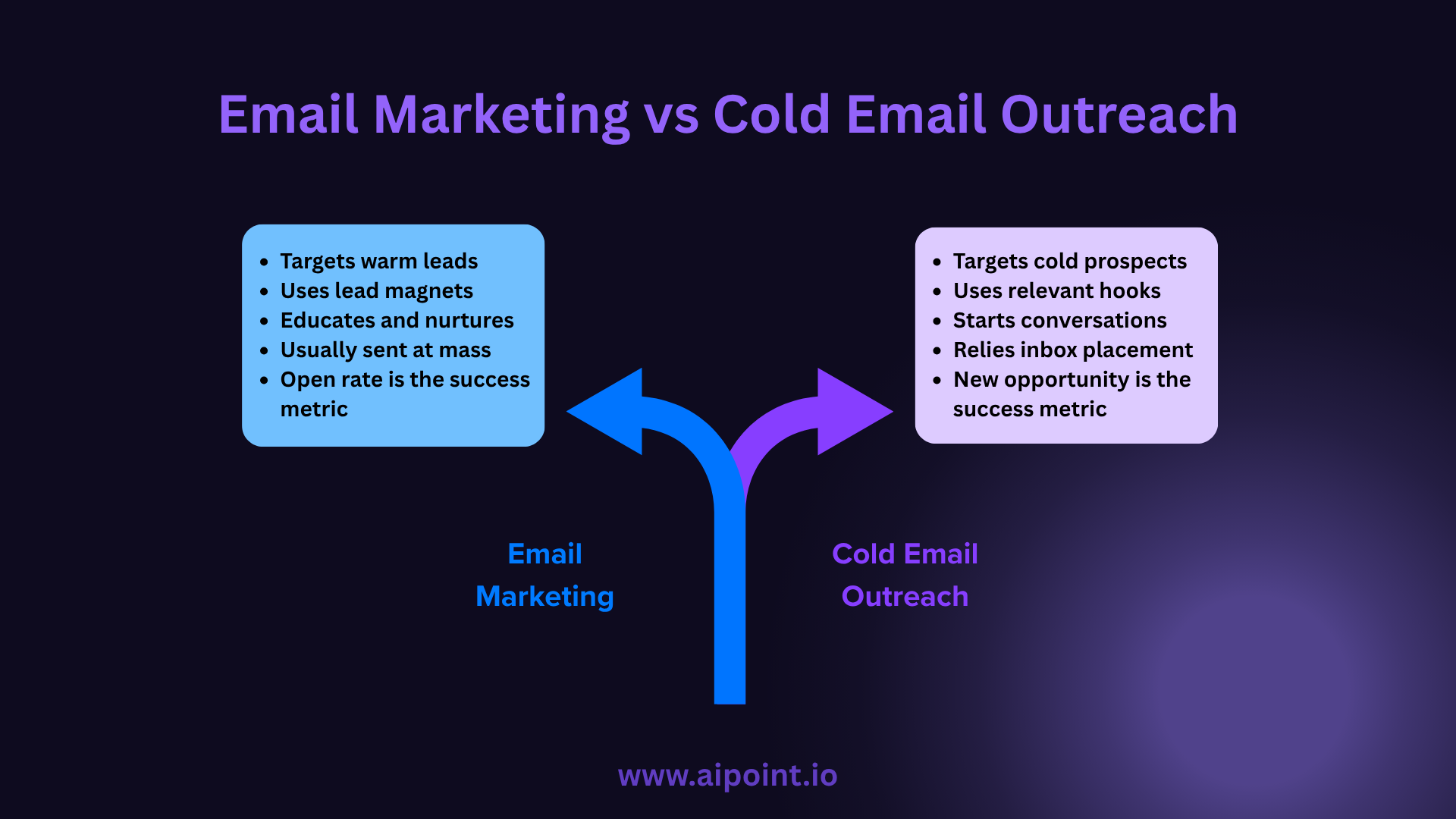

While both strategies use email as a communication channel, they target different audiences, require different messaging approaches, and are measured by different success metrics. Understanding these distinctions is essential for organizations looking to build an effective demand generation strategy.
This article explores the major differences between email marketing and cold email outreach, including audience targeting, message structure, lead generation tactics, deliverability considerations, and performance measurement.
Audience: Warm Leads vs Cold Prospects
The most significant difference between email marketing and cold outreach is the relationship between the sender and the recipient.
Email marketing is directed toward individuals who have already demonstrated some level of interest in a business. These contacts may have subscribed to a newsletter, downloaded a resource, attended a webinar, requested information, or previously purchased a product or service. Because the recipient has voluntarily engaged with the company, the relationship begins with a degree of familiarity and trust.
Cold email outreach, on the other hand, targets individuals who have had no prior interaction with the business. The recipient may not know the company, recognize its brand, or be actively searching for its solution. The purpose of cold outreach is therefore not to nurture an existing relationship but to initiate a new one.
This distinction influences every aspect of the email strategy, from messaging and personalization to expectations around engagement and conversion.
Lead Magnets vs Hooks
Email marketing typically relies on lead magnets to attract potential customers.
A lead magnet is a valuable resource offered in exchange for a prospect's contact information. Common examples include industry reports, guides, templates, webinars, assessments, and educational content. The prospect chooses to engage with the business and voluntarily enters the marketing funnel.
Because the prospect has already expressed interest, marketing emails can focus on educating, nurturing, and gradually moving the contact toward a purchasing decision.
Cold outreach operates differently. Since the recipient has not requested information, lead magnets are generally less effective as an initial engagement strategy. Instead, successful cold emails rely on a compelling hook.
A hook is a highly relevant observation, insight, or opportunity that captures the recipient's attention. It may reference a business challenge, market trend, recent company activity, hiring initiative, funding announcement, or other trigger event. The objective is to establish relevance quickly and provide a reason for the prospect to respond.
In email marketing, the recipient raises their hand first. In cold outreach, the sender must earn attention through relevance.
Email Structure and Messaging
The format of an email marketing message differs considerably from that of a cold outreach email.
Marketing emails often contain educational content, product updates, industry insights, customer stories, or promotional offers. Because recipients have opted into communication, they generally expect more detailed information. Marketing emails may include multiple sections, visual elements, links, and calls to action designed to encourage deeper engagement.
A typical marketing email may include:
- Educational content
- Articles or resources
- Product announcements
- Customer success stories
- Webinar invitations
- Promotional offers
Cold outreach emails are typically shorter and more direct. The primary objective is not to deliver extensive information but to start a conversation. Prospects are unlikely to invest significant time reading a lengthy email from an unfamiliar sender.
Effective cold emails generally focus on:
- A personalized observation
- A relevant business challenge
- A concise value proposition
- A simple call to action
Rather than attempting to explain everything in the first message, cold outreach seeks to create enough interest for the recipient to respond.
Personalization Requirements
Personalization plays a role in both strategies, but its importance differs significantly.
In email marketing, personalization is often limited to basic variables such as the recipient's name, company, industry, or behavior within the marketing funnel. Since the audience has already opted in, highly individualized messaging is not always necessary.
Cold outreach requires a much higher degree of personalization. Since recipients have no existing relationship with the sender, relevance becomes critical. Successful outbound campaigns often incorporate information such as company growth initiatives, hiring activity, technology adoption, market positioning, or recent business developments.
The goal is to demonstrate that the email was written specifically for the recipient rather than distributed to a large list.
Deliverability Considerations
Although both approaches rely on email delivery, the underlying sending models differ considerably.
Email marketing platforms are designed to distribute large volumes of messages to subscriber lists. Organizations may send thousands or even hundreds of thousands of emails in a single campaign. As sending volume increases, maintaining sender reputation becomes increasingly important.
Marketing teams must carefully manage:
- List quality
- Unsubscribe rates
- Spam complaints
- Engagement levels
- Sender reputation
Large-scale campaigns that generate low engagement or high complaint rates can experience deliverability challenges, including reduced inbox placement and increased spam filtering.
Cold email outreach generally follows a different operational model. Rather than sending large volumes from a single mailbox, modern outbound programs distribute sending activity across multiple inboxes and domains. When implemented correctly, inbox rotation and controlled sending volumes can help maintain deliverability while scaling outreach efforts.
Successful outbound programs typically emphasize:
- Dedicated sending domains
- Inbox rotation
- Gradual mailbox warm-up
- Conservative daily sending limits
- Ongoing deliverability monitoring
The objective is not maximum volume but consistent inbox placement and sustainable prospect engagement.
Measuring Success: Open Rates vs Pipeline Creation
One of the most common mistakes organizations make is applying email marketing metrics to cold outreach campaigns.
Historically, email marketers have relied heavily on metrics such as open rates, click-through rates, content engagement, and conversions. These metrics help determine whether subscribers are interacting with the content being delivered.
For marketing campaigns, questions often include:
- Are subscribers opening emails?
- Are they clicking links?
- Are they consuming content?
- Are they registering for events?
- Are they converting into customers?
While these metrics remain useful in a marketing context, they are less meaningful for cold outreach.
The primary objective of cold outreach is not content engagement but conversation generation. As a result, outbound teams focus on metrics that are directly tied to sales outcomes.
These typically include:
- Positive reply rates
- Conversation rates
- Meeting rates
- Opportunity creation
- Pipeline generated
- Revenue generated
Furthermore, privacy features introduced by major email providers have reduced the reliability of open-rate tracking. An email being opened does not necessarily indicate genuine interest, nor does it contribute directly to pipeline growth.
A campaign with modest open rates but strong reply rates may outperform a campaign with exceptional opens but no meaningful conversations.
For cold outreach, the most important question is not whether a prospect opened the email. It is whether the message was relevant enough to generate a response and create a sales opportunity.
Conclusion
Email marketing and cold email outreach are complementary strategies, but they serve different functions within the revenue generation process.
Email marketing is designed to nurture existing interest, educate prospects, and strengthen relationships with an audience that already knows the brand. It relies on permission-based communication and often uses lead magnets to attract and convert inbound interest.
Cold email outreach is designed to create new opportunities by initiating conversations with prospects who have no prior relationship with the sender. It relies on relevance, personalization, and carefully crafted messaging to earn attention and generate responses.
Organizations that understand these differences are better positioned to use both channels effectively. Rather than viewing email marketing and cold outreach as competing tactics, businesses should recognize them as distinct tools that support different stages of the buyer journey and contribute to a more predictable pipeline.
Related Blog


Ready for your
next market?